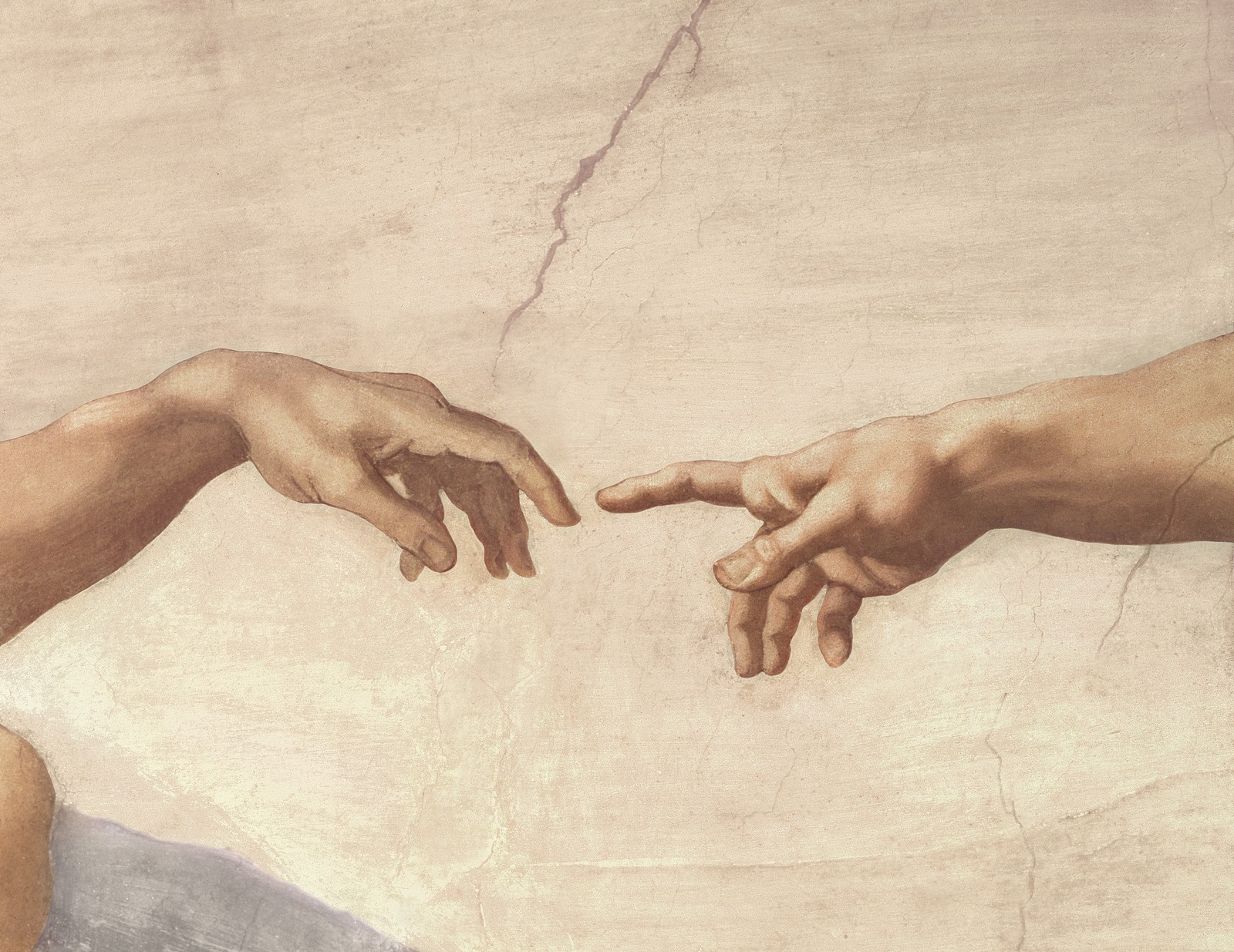

Why does this world exist at all?
In the previous article, we explored reincarnation through the lenses of Eastern philosophy, religions, and modern scientific research. Based on them, the conclusion could be drawn that existence is a kind of cosmic school – a vast, purposeful curriculum in which souls return again and again, inhabiting different bodies, relationships, and circumstances in order to grow, integrate, and ultimately remember what they truly are. It is a compelling framework, and for many people it immediately rings with a quiet inner recognition, as though something long forgotten is being named aloud for the first time.
But if you sit with that picture long enough, a deeper question begins to surface – one that the reincarnation model alone does not answer. If souls are here to learn and evolve, why do souls exist in the first place? If this is a school, who built it, and why? Why is there a universe at all? Why is there something rather than nothing? This is arguably the most ancient and radical question in all of spiritual inquiry, and unlike most questions, it does not yield to cleverness or analysis. It requires a different kind of attention – slower, more contemplative, more willing to sit with paradox. Here, many of the world’s great spiritual traditions diverge significantly, each offering a profoundly different answer, and yet each one illuminating a facet of something that may simply be too large for any single tradition to contain entirely.
God as Love That Needed Somewhere to Flow
The first framework comes from the great theistic traditions – Christianity, Islam, Jewish mysticism, and certain strands of devotional Hinduism – and it begins with a single, radical premise: God is Love. Not merely loving, not love as an attribute, but Love as the very nature of being itself. And here is the philosophical implication that follows: love, by its intrinsic nature, cannot exist in isolation. Love is relational. It requires an other – someone to pour itself into, someone to behold and be beheld by. A love with no object is merely potential energy, like heat with nowhere to radiate.
From this understanding, creation is not a mechanical process or a logical necessity. It is an overflow. God did not create the world because something was missing, but because something was so overwhelmingly present that it had to express itself outward. The mystic Meister Eckhart spoke of the boiling over of the divine nature – a kind of inner exuberance that could not remain contained. You might think of it as the difference between a great musician who composes not to fill silence but because the music inside them demands to be heard. Or a parent who brings a child into the world not from loneliness but from an abundance of love that yearns to be shared. In this framework, you are not an accident or an experiment. You are a desired companion. Your existence is the direct consequence of a Love that chose to have someone to love – someone with genuine freedom, capable of choosing to return that love rather than being compelled to. Free will, in this view, is not a design flaw but the whole point. A love that is coerced is no love at all.
The Universe as God’s Mirror
A second framework, which appears in the mystical currents of nearly every tradition – Sufism, Advaita Vedanta, Kabbalah, and also the New Age – begins from a very different premise. Here, the fundamental nature of reality is not relationship but unity. At the deepest level, there is only one thing: the Absolute, the undifferentiated ground of being, pure awareness before any object arises within it. This is what Vedanta calls Brahman, what the Taoists gesture toward with the word Tao, what the mystics across traditions encounter in states of deep contemplative absorption.
The paradox of this position is elegant and vertiginous: in its pure state, the Absolute cannot know itself. Knowing requires a knower and a known – a subject and an object – but in the state of pure undivided unity, there is no division, and therefore no self-knowledge in any experiential sense. It is like asking a vast ocean to observe its own depth; it needs something to reflect against. Creation, in this understanding, is the Absolute generating contrast – differentiation, perspective, multiplicity – so that it can experience and know itself through the prism of apparent separateness. Each soul is literally a viewpoint that God inhabits. Each pair of eyes looking out at a sunrise, each mind grappling with grief or wonder, each heart opened by love – these are the Absolute experiencing its own nature from a unique angle of perception. You are not separate from God looking for God. You are God, temporarily pretending not to know it, so that the knowing can happen again as if for the first time.
Lila: The Divine That Plays
Hinduism offers a third answer, and it is perhaps the most disarming of all because it removes the heaviness from the question entirely. In the Vedantic and Shaiva traditions, the cosmos is described as Lila – a Sanskrit word that translates roughly as “divine play.” The world is not a correction, not a school in the anxious sense, not a problem to be solved. It is a game that God plays with itself, not out of any deficiency but out of sheer creative exuberance. Think of a child who builds an elaborate world of toys not because they lack something but because imagination overflows into form naturally and joyfully. The building and the playing are their own purpose.
In this frame, God is the ultimate actor – simultaneously the playwright, the entire cast, and the audience – who chooses to forget the script so that the drama feels real. The forgetting is not a tragedy. It is the mechanism that makes the adventure possible. Alan Watts, who spent much of his life translating these Eastern ideas into language accessible to the Western mind, described it this way: the divine plays hide-and-seek with itself. It hides in each of us, so thoroughly that we genuinely believe we are alone, small, and separate – and then the entire spiritual path is the joy of finding out that it was God all along. The fear, the longing, the search, the sudden recognition – these are not mistakes. They are the texture of the game.
God That Grows Through Us
A fourth perspective, running through Theosophy, the work of Michael Newton’s regression research, and much of contemporary process theology, suggests something even more dynamic: that God is not static. Rather than a completed, unchanging perfection observing creation from outside, this framework proposes that the Absolute is itself in a process of expansion and self-discovery. Each soul that ventures into incarnation, accumulates experience, suffers, loves, creates, and eventually returns to the source – brings something new. Not just lessons, but lived textures of existence that did not exist in the Absolute before. Every act of genuine human compassion, every breakthrough of understanding, every moment of beauty recognized or beauty created – these enrich the very fabric of consciousness at the universal level. In this view, you are not merely a student. You are a collaborator. The universe becomes more conscious through you, and God – understood as the infinite ground of being – expands through the particular, irreplaceable experience of your existence.
Does the Answer Actually Change Anything?
Here is the honest and perhaps most important thing to say about all four of these frameworks: none of them can be proven. This is not a question that science will resolve, at least not with its current tools. And yet the question is not therefore meaningless – it is perhaps the most consequential question you can sit with, because your answer to it shapes everything else. It determines the story inside which you live your life.
The psychologist and philosopher William James observed that our beliefs are not merely passive descriptions of reality; they are active orientations that alter what we perceive and how we respond. The cosmology you inhabit – consciously or not – is the lens through which every experience is filtered. If you hold, even loosely, the understanding that you are a divine being in a purposeful game, then suffering becomes navigable in a way it simply is not when you believe you are a biological accident in an indifferent universe. This is not spiritual bypassing. It is perspective, and perspective is one of the most powerful instruments available to human consciousness.
Bringing these two conversations together – the reality of reincarnation and the deeper question of why existence exists at all – something interesting happens to your relationship with your own life. The Observer’s awareness becomes more real and understandable: neither detached nor disconnected, but no longer entirely consumed by the drama either. You are the actor who knows they are acting, the dreamer who knows they are dreaming, without that knowledge making the dream less vivid or the performance less committed. From this vantage point, your suffering does not disappear, but it stops being the final word. Your success does not inflate into ego, because you know it is one scene in a very long story. You can grieve fully, love fiercely, pursue your work with complete dedication – and simultaneously hold it all with a lightness that comes not from indifference but from a deep, quiet trust in the nature of the whole.
The question why does any of this exist may not have a single correct answer. But the act of genuinely asking it – and sitting with the answers these traditions offer – opens something in you. It relocates your identity from the fragment to the whole, from the wave to the ocean, and that relocation, even if only glimpsed for a moment, changes the quality of everything that follows.
Amid all these reflections, there is yet another question that can be asked: Who is the Creator of all this, and how was the Creator himself created? This, however, is a question I will not address, and I will quote just one sentence from the Tao Te Ching: “The Dao that can be described is not the eternal Dao”. There are no words that could answer this question, nor a mind that could comprehend it.