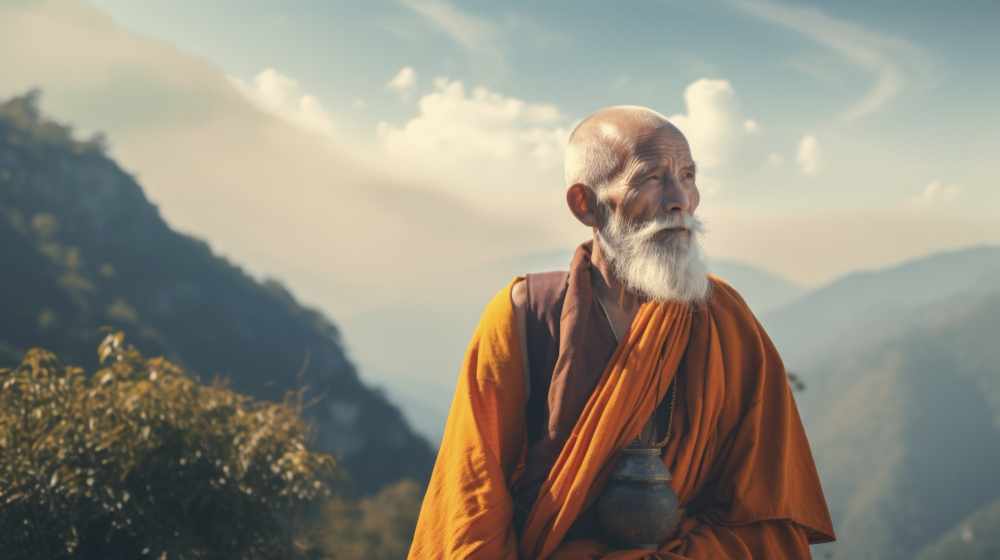

Different Types of Meditation in Hinduism
You’ve tried the mindfulness apps and maybe even a yoga class, but still feel like you’re only scratching the surface of meditation. What if the key isn’t to forcefully “clear your mind,” but to give it a fascinating job to do? Many of the techniques we use today have roots stretching back thousands of years to ancient India, where this very idea was central.
In Hinduism, this practice is known as Dhyana, a term for deep, meditative awareness. Its purpose often goes beyond simple stress relief and is seen as a profound journey of self-discovery and a path toward spiritual awakening. Far from being a single, rigid practice, ancient Indian meditation offers a rich menu of options for different personalities. Some people find stillness through sound, while others connect better with visual focus or quiet contemplation.
This guide explores accessible techniques you can try, from using a repeated sound to anchor your attention, to focusing on a simple object to quiet mental chatter, and finally, touching upon the profound practice of asking, “Who am I?” You’re about to discover a world of meditation that is deeper and more diverse than you might have imagined.
How a Simple Sound Can Anchor Your Mind: A Guide to Japa Meditation
If you’ve ever tried to quiet your thoughts, you know the mind often has other plans. It wanders, worries, and replays conversations, making silence feel anything but peaceful. This is where one of the most accessible Hindu meditation techniques comes in. Instead of fighting the mind, you give it a simple, focused job: repeating a sacred sound or phrase, known as a Mantra.
This practice is called Japa, which literally means “muttering” or “repeating.” Think of a mantra as an anchor for your awareness. By continuously repeating it – either aloud, in a whisper, or silently – you keep your mind from drifting away on the waves of random thought. Many practitioners use a string of 108 beads, called a mala, to keep count, adding a tactile element to the repetition that further grounds their focus. The simple, rhythmic action calms the nervous system and makes it easier to enter a meditative state.
One of the most universal mantras is OM (or Aum). In Hindu thought, it’s considered the primordial sound from which the universe emerged. For a beginner, its benefit is beautifully practical: it’s a sound that resonates through the body. The vibration provides a physical sensation to focus on, making it a powerful tool for concentration and one of the core OM mantra meditation benefits. It turns meditation from a purely mental exercise into a full-body experience.
To try a simple Japa practice, find a comfortable seat for five minutes. With your eyes closed, begin to repeat the mantra “OM” at a pace that feels natural. You can say it aloud to feel the vibration or repeat it silently in your mind. When your mind wanders, gently guide it back to the sound. This auditory focus is a powerful entry point, but it’s not the only way. For those who are more visually oriented, another ancient technique uses the eyes to find stillness.

Find Focus in a Flame: The Power of Trataka Meditation (Candle Gazing)
While sounds can anchor the mind, our sense of sight offers an equally powerful pathway to stillness. Have you ever found yourself completely mesmerized by a campfire, your thoughts melting away as you stare into the dancing flames? This experience is the foundation for an ancient Indian meditation for focus known as Trataka, or steady gazing. The principle is simple: by giving your eyes a single, stable object to rest upon, you give your mind a stable anchor. Instead of chasing a whirlwind of thoughts, your attention learns to settle.
To practice Trataka meditation safely, find a dim, quiet room and place a candle at eye level, about an arm’s length away. Sit comfortably and let your eyes gaze softly at the steady part of the flame, just above the wick. Try to keep from blinking for as long as it feels comfortable, without straining. When your eyes begin to water or feel tired, gently close them. Now, with your eyes shut, bring your awareness to the space between your eyebrows and observe the after-image of the flame that lingers in your mind’s eye.
The real magic of this practice happens when your eyes are closed. Holding your attention on that internal, fading image of the flame trains your concentration in a profound way. It’s a bridge from external focus to internal stillness, making it a highly effective Hindu meditation for stress and anxiety. This powerful technique shows how an object can lead to inner quiet. But what if the object of focus was something you carry with you everywhere?

Your Breath as an Anchor: The Hindu Roots of Mindfulness
That object you carry with you everywhere is, of course, your own breath. You may have already encountered this idea through modern mindfulness apps, but the practice of using the breath as a focal point has been a cornerstone of Hindu meditation for stress and anxiety for millennia. The logic is elegant and simple: while sounds, sights, and thoughts come and go, your breath is a constant, reliable rhythm. By resting your attention on its gentle ebb and flow, you give your wandering mind a home base to return to, moment by moment.
A key distinction is that this practice is about simply observing the breath, not trying to change or control it. Think of it like watching waves on a shore without interfering with their natural pattern. This gentle awareness is different from the more active breathing exercises, known as pranayama, which are also a vital part of many Vedic meditation practices. While both are powerful, simple observation is the foundational skill for cultivating a calm and steady mind.
You can experience this anchor right now. Just take a moment to sit comfortably and close your eyes. Don’t try to breathe deeply or slowly; simply notice the natural sensation of your breath. Where do you feel it most – the coolness in your nostrils, the rise and fall of your chest, or the expansion of your belly? Let your attention rest on that spot, as if it were the most interesting thing in the world. When your mind wanders, gently guide it back. These a-la-carte practices are powerful tools, but the different paths of yoga meditation also offer broader systems tailored to our personalities.
Head vs. Heart: Which Yogic Path of Meditation Suits You?
The existence of so many different paths of yoga meditation leads to a core insight from the ancient sages: we are all wired differently. What works for a structured, analytical mind might not resonate with a more emotional, creative person. This is where two of the most prominent paths diverge: Raja Yoga, the path of the head, and Bhakti Yoga, the path of the heart.
For those who are more analytical, Raja Yoga offers a systematic, step-by-step method for mastering the mind. Often called the “royal path,” its techniques are famously outlined in Patanjali’s Yoga Sutras. Think of it as a form of mental training where you use discipline and concentration to still the restless “chatter” of your thoughts. The goal of its meditative state, Dhyana, is to achieve unwavering focus through deliberate control, much like an athlete training for peak performance.
In contrast, Bhakti Yoga is the path of devotion and emotional connection. Instead of trying to suppress the mind’s waves, this practice channels them into a powerful current of love or reverence. For a practitioner, this could mean focusing on a deity, a spiritual teacher, or even an abstract concept like universal compassion. The goal is to become so absorbed in that feeling of love that the ego and distracting thoughts simply melt away. It’s a path of surrender, not control.
The question of Raja Yoga vs. Bhakti Yoga meditation is less about which is superior and more about which is a better fit for your personality. One path uses willpower to quiet the mind, while the other uses love to fill it so completely there is no room for anything else. Both are considered valid routes to the same destination: a state of profound inner stillness. But what if the object of your focus is neither a deity nor pure awareness, but a specific idea or quality?
Meditating on an Idea: Using Visualization for Inner Peace and Strength
Focusing on a specific quality – like peace, strength, or compassion – is a cornerstone of many Hindu meditation techniques for beginners. This approach is known as Saguna Dhyana, which translates to “meditation with form” or “with attributes.” Instead of trying to empty the mind or surrender in devotion, you give your mind a constructive, creative task: to hold a tangible idea or image as its focal point. This form could be a symbol, a natural element like a mountain, or simply a point of light that represents the quality you wish to embody.
For instance, if you’re feeling anxious, you might practice this by visualizing a steady, warm light in your heart center. With each breath, you could imagine this light of peace growing brighter and more stable, slowly expanding to soothe every part of your body and mind. This method uses the power of imagination not as a distraction, but as a direct tool for influencing your inner state. Some forms of modern chakra balancing meditation guides draw from this same principle, using visualized colors and energies to restore a sense of inner harmony.
This type of meditation is a powerful way to actively cultivate specific emotional and mental states. By repeatedly focusing on an image of strength, you are mentally rehearsing that feeling, making it more accessible in your daily life. It’s a way of proving to yourself that your mind can be an artist, shaping your inner world with intention. But while focusing on a form is a powerful anchor, some paths invite you to go one step further: to let go of the anchor entirely and explore what remains.
The Ultimate Question: Using Self-Inquiry to Ask “Who Am I?”
After practicing with an anchor like a sound or image, what happens when you let it go completely? This leads to a more abstract practice known as Nirguna Dhyana, or meditation without form. Instead of giving the mind something to focus on, the goal is to rest in the awareness that exists underneath it all. Imagine you’ve been watching boats (your thoughts) on a river. Now, you shift your attention to the river itself – the silent, flowing consciousness in which everything appears.
One of the most direct paths to this experience is Self-Inquiry meditation, a practice central to the philosophy of Advaita Vedanta – a school of thought focused on the idea of a single, universal consciousness. This profound approach, often considered a form of meditation for spiritual awakening in Hinduism, uses a simple but powerful question: “Who am I?” The goal isn’t to find a verbal answer like “I am a person” or “I am my job,” but to use the question as a tool to redirect attention inward, away from the passing thoughts and toward the source of awareness itself.
You can glimpse this shift right now. Notice a thought or feeling that’s present. Instead of following it, gently ask internally, “Who is aware of this?” Don’t search for an answer. Just let the question create a space and turn your attention back to the silent observer within. Exploring these different forms of meditation, from simple repetition to deep inquiry, naturally leads to a personal question: which path is right for you?
Which Hindu Meditation is Best for You? A Starter’s Guide to Choosing Your Path
With such a diverse landscape of meditative practices, the natural question is where to begin. The answer lies in your own nature. Use this simple guide to find a starting point among these Hindu meditation techniques for beginners.
Which path might fit you?
- If your mind is restless and needs a job to do, try Japa Meditation (Mantra).
- If you are a visual person who likes concrete focus, try Trataka (Candle Gazing).
- If you want to cultivate positive feelings like love or peace, try Saguna Meditation (Visualization).
- If you are naturally philosophical and curious about consciousness, explore Self-Inquiry.
Your first step isn’t to master a technique, but simply to begin. Choose one path that feels right and commit to a small experiment: five minutes a day for one week. You’re not trying to achieve perfection, but simply starting a conversation with yourself.