
Metatron’s Cube, Explained: The Sacred Geometry Symbol Hiding Five Perfect Shapes
There is a shape that keeps showing up. On necklaces in crystal shops, tattooed on forearms, printed on meditation cushions, hovering in the corner of some Instagram infographic about “raising your vibration.” It looks like a cube, sort of, except it’s made of circles and straight lines that overlap into something far too intricate to be just a cube. Most people scroll past it without ever finding out what it is, where it came from, or why an angel supposedly has his name on it. Which is a shame, because once the thing actually gets explained, it stops looking only like decoration.
Who Is Metatron?
Before touching the geometry, it helps to know who’s apparently responsible for it. Metatron shows up in Jewish mystical literature, most famously in a text called 3 Enoch, as one of the highest-ranking beings in the celestial hierarchy — sometimes called the “Prince of the Presence,” sometimes described as the biblical figure Enoch after he was taken up into heaven and transformed. According to the historical record on Metatron, he’s often pictured as a celestial scribe, the one keeping the cosmic ledger of everything that happens down here, close enough to the divine that some texts call him “the lesser Yahweh.”
You don’t have to buy into any of the theology to get something useful out of this. What matters for our purposes is the role: a being whose entire job is recording, organizing, and holding the blueprint of creation. That’s a wildly fitting job description for the shape that eventually got named after him, because Metatron’s Cube isn’t really a “cube” in the geometry-class sense. It’s a diagram. A cosmic filing system. Some say it’s literally a rendering of the structure Metatron uses to keep the universe from falling into chaos — the architecture behind the architecture.
What exactly is Metatron’s Cube?
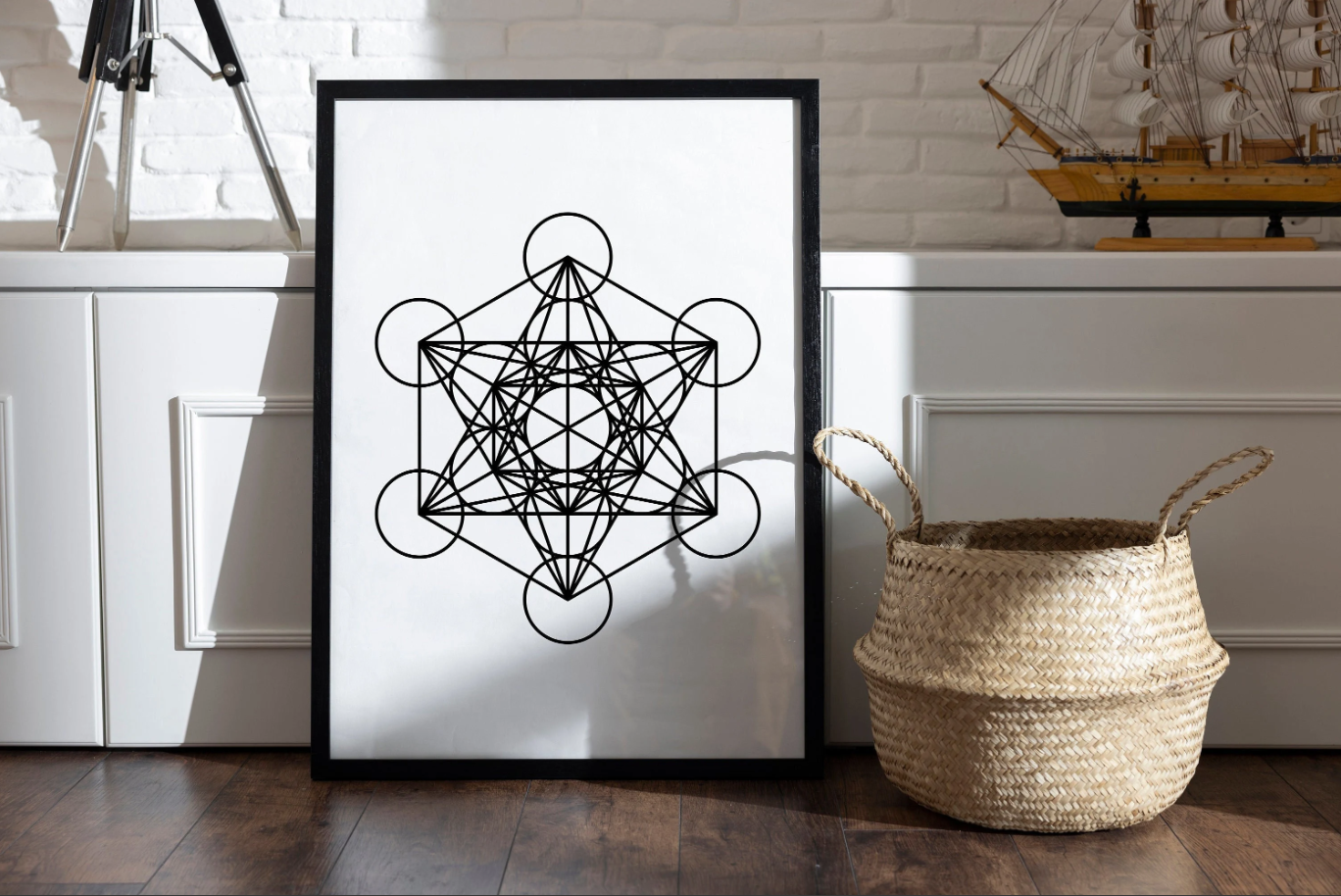
Strip away the mysticism for a second and look at the thing itself: it’s thirteen circles of equal size, their centers connected by straight lines running to every other center. That’s it. That’s the whole recipe. But the effect of connecting all those points is where it gets interesting, because the resulting web of lines doesn’t just look busy — it contains, hidden in plain sight, the outlines of five specific three-dimensional shapes that ancient philosophers considered the literal building blocks of physical reality.
So Metatron’s Cube functions on two levels at once, and this is the part beginners usually miss. On the surface, it’s a flat, two-dimensional pattern you could doodle in a notebook. But tilt your perception slightly and it reveals a three-dimensional skeleton underneath, like one of those magic-eye posters except the hidden image is the architecture of matter itself. That double nature — flat and dimensional, simple and infinitely complex — is basically the whole point. It’s a reminder that what looks ordinary on the surface is usually holding something much bigger underneath, which, if you squint, is also a decent description of a human being.
How is Metatron’s Cube created? Building It From Scratch
You don’t need a compass and a physics degree to understand the construction, though grabbing a piece of paper genuinely helps. Start with one circle in the center. Surround it with six more circles of the same size, each one touching the center circle and its two neighbors, which gives you a classic six-petal flower shape. Then add six more circles around that ring, doubling the outer layer. You now have thirteen circles total, arranged in perfect symmetry, looking a bit like a snowflake that took a geometry class.
The final step is the one that turns it into “the Cube.” Take the center point of every single circle and draw a straight line connecting it to the center point of every other circle. Do this by hand and you’ll watch a genuinely beautiful, chaotic-looking web emerge from thirteen humble little circles, and somewhere inside that web, the outlines of cubes, pyramids, and other solids start winking at you.
Thirteen Circles, One Stubborn Number, and Five Perfect Solids
The number thirteen gets a bad reputation in Western superstition, mostly thanks to unlucky floors in hotels and horror movies. But long before triskaidekaphobia became a thing, thirteen was considered a number of transformation across an enormous range of traditions — the number of lunar cycles in a solar year, the card of Death in the tarot (which, contrary to the jump-scare reputation, symbolizes rebirth rather than literal doom), a number tied to completion followed by renewal. In Metatron’s Cube, thirteen circles aren’t decorative math — they’re widely read as the twelve archetypal forces or energies of creation, plus one center point representing the divine source they all radiate from. Twelve around one. A wheel with a hub.
And then there’s the part that made ancient philosophers lose their minds a little: hidden within those connecting lines are all five Platonic solids — the tetrahedron, cube, octahedron, dodecahedron, and icosahedron. These five perfectly symmetrical forms were mapped by Plato onto the classical elements — fire, earth, air, water, and ether — and treated as the literal geometric DNA from which the physical world gets built. Finding all five nested inside one diagram made of nothing but circles and lines is either an extraordinary mathematical coincidence or, depending on which lens you’re looking through, proof that geometry itself is a kind of scripture. Either way, it’s the reason Metatron’s Cube gets called a map of creation rather than just a pretty pattern. It’s supposedly showing you, in one glance, every fundamental shape the universe uses to build itself.
From Flower to Fruit to Cube: A Bit of a Family Tree
If Metatron’s Cube feels distantly related to the Flower of Life, that’s because it basically is its grandchild. The Flower of Life is the big one — a sprawling pattern of nineteen or more overlapping circles that shows up carved into temple walls and stone columns across wildly different, disconnected ancient cultures, from Egypt to Turkey to China, which is part of why it fascinates people so much. Nobody quite agrees on how the same pattern ended up scratched into stone by civilizations that supposedly never met.
Zoom into the center of the Flower of Life and pull out just thirteen of those circles — the ones arranged in that tight, symmetrical cluster — and you get what’s called the Fruit of Life. It’s the seed at the center of the flower, structurally speaking. And Metatron’s Cube is simply what happens when you take the Fruit of Life and connect every center point to every other center point with straight lines. Flower gives you the field. Fruit gives you the seed. Cube gives you the blueprint hiding inside the seed. It’s less a trio of unrelated symbols and more a single idea unfolding in stages, like watching a photograph slowly develop.
A Cosmic Bodyguard: Metatron’s Cube as a Symbol of Protection
Long before it became a jewelry motif, Metatron’s Cube carried a reputation as a shield. The logic tracks pretty intuitively once you sit with it: a shape built from every point connecting to every other point, with no gaps and no weak spots, naturally reads as a symbol of wholeness and containment. Nothing gets in or out that isn’t accounted for. People working with the symbol often describe it as a kind of energetic bouncer — placed at the edge of a space, worn close to the body, or simply visualized around oneself, its job is to filter out chaotic, draining, or unwelcome energy while letting what’s actually nourishing pass through.
This is where the symbol quietly overlaps with plain old psychology, if you’re the type who prefers your spirituality with a side of practicality. Having a mental image of a structured, ordered boundary — something with a clear architecture instead of a vague “keep negativity away” wish — gives the mind something concrete to hold onto in moments of overwhelm. Visualization is a documented tool for calming the nervous system regardless of what you believe about angels, and Metatron’s Cube happens to be an unusually rich, detailed image to visualize. The mysticism and the mental-health mechanism aren’t in competition here. They’re doing the same job from two different doors.
Reiki Rooms, Meditation Cushions, and Your Chakras: The Cube in Modern Practice
Walk into a Reiki session these days and there’s a decent chance the practitioner has a Metatron’s Cube grid somewhere in the room, or printed on the table you’re lying on, or tucked under a crystal layout. Energy workers frequently use the symbol as an amplifier — a structure believed to organize and direct healing energy more efficiently, the same way a lens focuses scattered light into a single, usable beam. Crystal grids built in the Cube’s pattern are popular for exactly this reason: place stones on the intersecting points, set an intention, and the geometry supposedly does some of the organizing work for you.
In meditation, the Cube often gets used as a focal point rather than something to think about — you simply rest your gaze or your mind’s eye on the image and let its complexity absorb the usual mental chatter, the same function a mandala serves in Buddhist practice or a yantra serves in Hindu tantra. And in chakra work, some practitioners place a small version of the symbol over each energy center during a session, treating it as a stabilizer that helps a wobbly or blocked chakra hold a clearer, steadier structure.
Okay, So How Do You Actually Use This Thing?
Here’s where theory hands the baton to practice, which, if you know anything about how this blog operates, is the part that actually matters. Owning a Metatron’s Cube pendant or hanging a print on your wall does approximately nothing on its own — the symbol works the way a gym membership works, which is to say, only if you show up.
A simple starting point is a five-minute morning gaze meditation: pull up an image of the Cube, sit somewhere quiet, and let your eyes trace the lines without forcing any particular thought. Some people find their mind naturally settles into the kind of loose, spacious awareness that usually takes much longer to reach through breath-focused meditation alone, because the geometry is doing some of the settling for you. Others use it as a protection ritual before something draining — a difficult conversation, a crowded event, a long shift dealing with the public — by closing their eyes, picturing the Cube expanding outward from their chest until it forms a sphere around the whole body, then simply carrying on with the day inside that imagined structure.
It also works beautifully as a grounding object for a home altar or a workspace, especially for anyone who processes information visually rather than verbally. Keep it near where decisions get made, where journaling happens, where the day starts or ends, and let it act as a quiet reminder that whatever feels scattered or chaotic right now is still, underneath, part of something ordered.
And above all, remember Metatron himself. He’s not just some figure from mythology — believe that he exists. And believe, too, that he doesn’t need rhyming, complicated prayers, but simply a single sentence from your heart. Just ask him for help, wisdom, guidance, protection, healing — whatever else you need. Just because you can’t see him doesn’t mean he isn’t there.