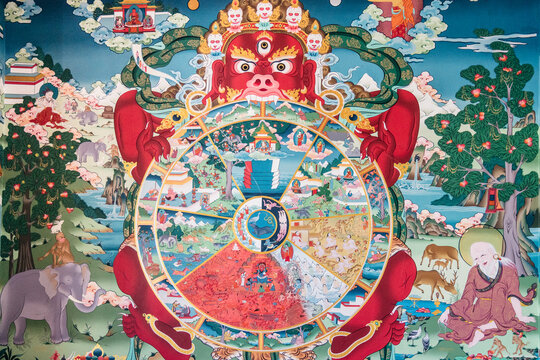

Pathways to Liberation from Samsara
Samsara. Eastern philosophy uses this Sanskrit term, often translated as “wandering through,” to describe the samsara cycle – a repetitive loop of habitual suffering and conditioned existence. Much like a hamster running frantically on a wheel, we often exert immense energy chasing external goals, only to find ourselves emotionally exactly where we started. It is a state where our happiness is constantly held hostage by circumstances we cannot control.
Psychologists describe similar patterns when discussing the “hedonic treadmill,” observing that new purchases or achievements rarely provide lasting satisfaction. We remain trapped in this wheel of suffering because we mistakenly believe the solution to our unease lies in fixing the world around us rather than addressing the perceptions within us. As long as we react to life with the same automatic habits, the outcome remains inevitably the same.
Fortunately, recognizing this pattern is the first step toward freedom. Breaking the cycle of samsara does not require you to abandon your life or move to a mountaintop; instead, it involves shifting your internal perspective to find a peace that doesn’t depend on everything going perfectly.
The Three Invisible Forces That Fuel Your Habitual Loop
Imagine drinking salt water to quench your thirst. The more you gulp down, the more dehydrated you become, driving you to drink even more in a frantic attempt to find relief. This paradox sits at the heart of the samsara cycle, acting as the fuel that keeps the wheel of dissatisfaction spinning. It isn’t that the world is inherently punishing; rather, our internal reactions create a friction that stops us from ever feeling truly at rest.
Tradition calls this fuel the “Three Poisons,” but you likely recognize them as the psychological triggers that complicate ending attachment to worldly desires:
- Attachment (Greed): The dopamine-seeking urge that says, “I need this to be happy.” It is the compulsion to check your phone or buy the next upgrade, only to feel empty shortly after.
- Aversion (Hatred): The active resistance that says, “I cannot stand this.” This appears as knee-jerk irritation toward traffic, difficult people, or uncomfortable emotions.
- Ignorance (Delusion): A fundamental confusion about reality, specifically the mistaken belief that temporary experiences can provide permanent security.
Caught between the tension of chasing what we want and running from what we fear, we exhaust ourselves on a treadmill of our own making. Overcoming karmic patterns and suffering begins when we realize these reactions are not mandatory; they are simply habits we have practiced for too long. Once you identify the fuel, you must examine the engine itself – a mechanism often misunderstood as cosmic punishment, but better understood as psychological momentum.
Beyond Good and Bad: Understanding Karma as Psychological Momentum
Viewing karma solely as a cosmic scorecard misses its practical power. In this framework, karma isn’t about moral judgment or divine retribution; it is simply the law of psychological momentum. Just as a ball rolling downhill gathers speed, every thought and action generates kinetic energy that pushes your mind in a specific direction. When you act out of kindness or anger, you aren’t just affecting the world – you are training your brain to repeat that behavior more easily next time.
The difference between karmic debt vs spiritual merit is not a mystical bank balance, but the depth of a groove in the road. Every time you react to stress with anxiety or seek comfort in distraction, you carve that neurological path a little deeper. Eventually, the ruts become so entrenched that your wheels slip into them automatically, making it feel impossible to steer a different course. This accumulated weight of habit is what traditions call karmic debt – it is the sheer difficulty of changing a behavior that has been reinforced thousands of times.
Breaking samsara requires recognizing that you are the architect of these ruts. Overcoming karmic patterns and suffering doesn’t happen by magic, but by consciously steering against the pull of your old habits to forge new, shallower paths. Effective action requires understanding the intricate chain of events that triggers the wheel to spin in the first place.
The Hidden Mechanics of Reality: How Dependent Origination Keeps Us Stuck
Ever wonder why a simple notification on your phone triggers hours of doom-scrolling before you even realize what happened? This isn’t just a lack of willpower; it is a predictable chain reaction known in Eastern philosophy as Dependent Origination. This law states that nothing exists in isolation – every moment of suffering arises because specific conditions came before it. Understanding the law of dependent origination allows you to see that your “automatic” bad habits are actually composed of distinct, interruptible steps.
This engine operates visibly when a single moment of stress unfolds in real-time:
- Trigger (Contact): You receive a vague “We need to talk” text from a boss or partner.
- Perception (Feeling): Your mind instantly labels this stimulus as “threatening,” generating a physical pang of anxiety.
- Reaction (Craving): To escape that unpleasant sensation, you reflexively seek distraction or prepare a defensive argument.
Most of us live entirely in the third step, reacting blindly to whatever feelings arise. However, breaking the cycle of samsara – that feeling of being trapped in repetitive loops – becomes possible only when you notice the split-second gap between the perception and the reaction. You cannot always control the trigger, but you can learn to pause before the automatic demand to “fix” the feeling takes over.
By slowing down this process, you regain your agency. You realize that while the initial spark of anxiety is inevitable, the bonfire of drama that usually follows is optional. Once you identify these hidden links, you need a practical strategy to dismantle them, revealing the ultimate roadmap for those seeking to escape samsara.
Mapping the Exit: Using the Four Noble Truths to Stop the Struggle
Think of your recurring struggles as a chronic illness that finally needs a specialist’s attention. The significance of the four noble truths lies in their pragmatic, medical approach to the human condition: diagnosing the symptom, identifying the cause, confirming a cure exists, and prescribing a treatment. The first truth identifies the symptom as Dukkha, a term often translated as “suffering,” though it more accurately describes a pervasive sense of unsatisfactoriness or friction. It is the feeling that even when things are good, they are fragile and temporary, leaving us constantly anxious about the next change.
Once you accept that this friction is a natural side effect of relying on temporary things for permanent happiness, the path forward clears. You realize that samsara enlightenment isn’t about escaping to a different world, but rather curing the fever of craving that distorts how you see this one. The “prescription” is a set of practical lifestyle adjustments – from how you speak to how you focus your mind – designed to cool the heat of reactivity and replace blind impulse with conscious awareness.
Applying this prescription daily rewires your responses to stress, slowly dismantling the automatic habits that keep you stuck in loops of frustration. This process of untangling the mind is the practical mechanic behind achieving spiritual liberation from rebirth – whether you view that as a literal future life or simply the rebirth of your bad habits tomorrow morning. As the fever breaks, we must distinguish the ultimate destination, examining the subtle differences between the stillness of Nirvana and the union of Moksha.
Reaching the Far Shore: Distinguishing Between Nirvana and Moksha
Breaking the fever of constant craving leads to the ultimate goal of these traditions: liberation. Rather than floating away on a cloud, achieving spiritual liberation from rebirth is like finally putting down a heavy backpack you forgot you were wearing. It is the cessation of the compulsive mental noise that dictates your reactions, allowing you to experience life directly without the distortion of constant want or worry.
Although the destination is freedom, the descriptions of the landscape vary. The primary differences between nirvana and moksha center on the self. In Buddhism, Nirvana is the “blowing out” of the ego’s flame, extinguishing the heat of suffering to reveal peace. Conversely, the Hindu concept of Moksha is like a drop of water returning to the ocean, realizing unity with the infinite source. Both offer the same relief: the end of isolation and fear.
Regardless of which metaphor speaks to you, the result is profound inner resilience. However, understanding what leads to spiritual transcendence requires moving beyond theory, as philosophy alone cannot dismantle years of conditioned habits. To transform these ideals into reality, we need a structured framework to guide our daily choices.
The Eightfold Path: A Step-by-Step Blueprint for Spiritual Sovereignty
If the Four Noble Truths are the diagnosis of our chronic dissatisfaction, the noble eightfold path to enlightenment is the prescription for a cure. This framework is not a linear ladder where you climb the first rung and leave it behind; rather, it functions like a holistic wellness plan where diet, exercise, and sleep all reinforce one another. Just as you cannot build physical health by exercising while eating poorly, escaping the wheel of suffering requires simultaneously addressing your mindset, your behavior, and your focus.
To make these ancient instructions usable for modern life, they are traditionally organized into three practical pillars:
- Wisdom: Aligning your perspective with reality (Right View) and committing to non-harming motivations (Right Intention).
- Ethical Conduct: Reducing friction in your life through integrity in communication (Right Speech), behavior (Right Action), and career choices (Right Livelihood).
- Mental Discipline: Cultivating emotional resilience through sustained energy (Right Effort), present-moment awareness (Right Mindfulness), and deep focus (Right Concentration).
Applying this blueprint starts with small, conscious pauses rather than drastic lifestyle changes. For instance, practicing “Right Intention” might simply mean asking yourself, “Am I sending this text to connect or to control?” before hitting send. Similarly, “Right Mindfulness” is not limited to sitting on a cushion; it is the act of noticing the urge to doom-scroll and gently choosing to put the phone down.
Taking these steps to attain final liberation gradually rewires your brain, replacing automatic reactions with responsive choices. As the noise of constant reactivity quiets down, you prepare yourself for the subtle art of engaging with the world deeply without getting stuck to it.
The Power of Non-Attachment: Finding Peace Without Giving Up Your Life
When hearing about ending attachment to worldly desires, many fear they must sell their possessions or numb their emotions to achieve serenity. However, true liberation is not about apathy or rejection; it is the art of participating fully in life without clutching it so tightly that you crush the joy out of it. Think of it as the difference between holding a breath and breathing; attempting to hold onto air creates tension and panic, while allowing it to flow in and out sustains life.
The role of mindfulness in spiritual awakening is to help you recognize the precise moment your appreciation morphs into possession. You can enjoy a beautiful sunset, a delicious meal, or a success at work, but the moment you demand that these fleeting experiences last forever, you invite suffering back in. By practicing non-attachment for inner peace, you shift from an anxious owner to a grateful guest; you savor the experience while it is present and gracefully open your hand when it is time for it to pass.
Mastering this balance transforms your relationship with the inevitable ups and downs of existence. Instead of being dragged behind the chariot of change, you learn to ride within it, finding stability even as the landscape shifts around you. This emotional freedom clears the fog of neediness, allowing you to finally perceive the underlying reality that governs all these changes.
Transcending Reality: How Realizing the True Nature of Truth Ends the Cycle
Often, the biggest obstacle to lasting peace isn’t the chaotic world around us, but the rigid story we tell ourselves about who we are. We constantly build invisible walls to protect our “self” – our reputation, our desires, and our history – believing we are solitary islands fighting against a hostile tide. In Eastern philosophy, this intense focus on a separate, solid ego is actually the architect of the cage that keeps us trapped in repetitive suffering. Realizing the true nature of reality begins when you finally inspect these walls and discover they aren’t made of stone, but of habits and thoughts you can choose to stop reinforcing.
Dismantling this cage requires looking toward the concept of Sunyata, often translated as “Emptiness,” though it is better understood as “Interconnectedness.” Imagine a wave rising on the ocean; it looks distinct, with a specific height and shape, but it is never actually separate from the water. If the wave believes it is an isolated entity, it lives in terror of crashing into the shore, yet if it realizes it is the ocean, that fear dissolves. Samsara enlightenment isn’t about escaping to a different physical realm, but shifting your perspective to see that you are the water, inextricably linked to everything else, rather than a fragile wave fighting to survive alone.
This radical shift in perspective is the ultimate key to breaking the cycle of stress and reaction. When you stop defending a rigid ego, the habitual triggers of craving and aversion lose their fuel, allowing you to move through life with fluidity rather than friction. Understanding that you are part of a larger flow is what leads to spiritual transcendence, turning the terrifying cycle of repetition into a liberating dance of existence.
Your First Step Toward Liberation: Moving from Reactivity to Presence
You started this journey recognizing the “Groundhog Day” effect of your daily habits. Now, you understand the machinery behind them. Breaking the cycle of samsara isn’t about escaping reality or fleeing to a mountaintop; it is about recognizing that you hold the keys to your own mental cage. You have moved from feeling like a victim of circumstance to becoming an observer of your own patterns.
You do not need to wait for a major life crisis to apply these insights. The most powerful changes happen in the micro-moments of your day. Whenever you feel the familiar tug of irritation or a craving that you know won’t satisfy you, use that friction as a signal to pause rather than react.
To help you step off the treadmill of habit, try this simple “Circuit Breaker” exercise:
- Pause: Stop physically for one full breath. This creates a vital gap between the trigger and your automatic reaction.
- Name It: Silently identify the feeling (e.g., “This is anger” or “This is a craving”) to separate your identity from the emotion.
- Choose: Consciously select a response that serves your peace rather than feeding the loop.
Ultimately, learning how to stop the cycle of reincarnation – or simply the cycle of a stressful Tuesday – relies on progress, not perfection. By practicing non-attachment for inner peace, you trade the exhaustion of the hamster wheel for the clarity of the present moment. Each conscious choice is a small victory that slowly dismantles the walls of the maze, leaving you free to enjoy the walk.