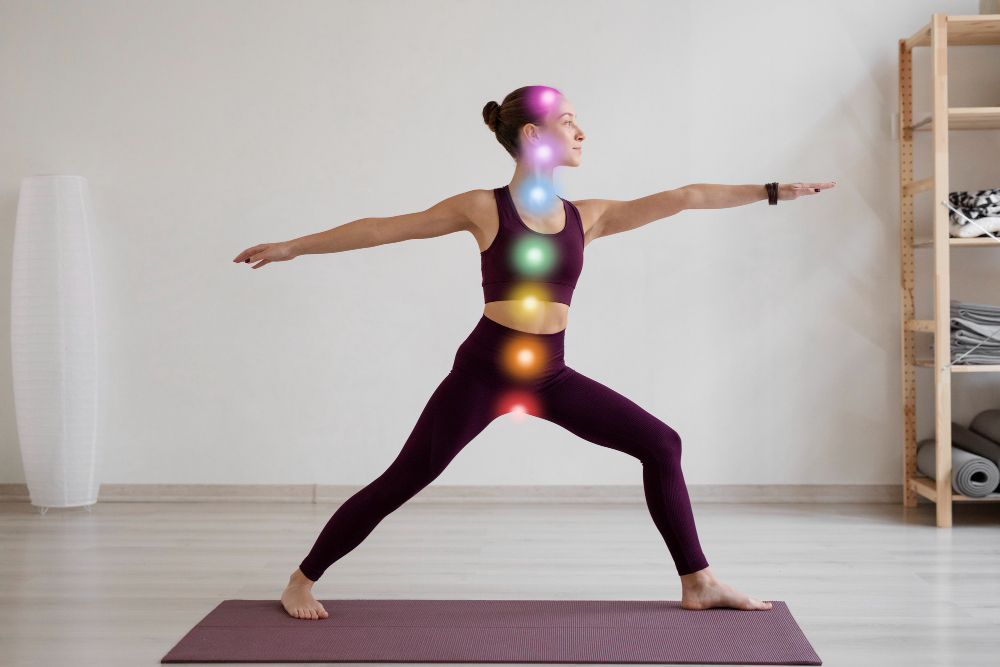

The Invisible Architecture of Life: Energy, Chakras, Meridians, and Aura
Let’s talk about energy. This word gets thrown around a lot, and it’s worth grounding it in something real. In the context of spiritual and energetic traditions, energy doesn’t mean electricity or calories. It refers to the animating life-force that flows through all living things. Different traditions gave it different names, but the understanding behind those names is strikingly similar.
In India, this force is called Prana – the breath of life, the intelligence that animates the body and connects the individual to the cosmos. Prana isn’t just what you breathe; it’s what you are, on the most fundamental level. In China, the same force is known as Qi (or Chi) – the vital energy that flows through the body in specific pathways and governs health, emotion, and vitality. Traditional Chinese Medicine has built an entire healing system around the movement of Qi. Move to the Pacific Islands and you encounter Mana – a sacred power that can reside in people, objects, and places, and that grows through right action, lineage, and spiritual practice. Among the ancient Slavs, this living force was called Żywa, rooted in the word for “life” itself – a primal, earthly vitality woven into nature and the human spirit. And in the Christian tradition, especially in its mystical branches, a comparable concept exists in the Spirit (Pneuma in Greek) – the divine breath breathed into humanity at the moment of creation.
What’s remarkable isn’t the names, but the consensus. From shamans in Siberia to yogis in the Himalayas, from Taoist sages to medieval Christian mystics – humanity has always intuited that there is something more running through the body than blood and bone. And you can feel it. That tingling in your hands during a deep meditation, the sudden heaviness in your chest when someone shares bad news, the lightness after a long walk in the forest – that’s energy. You already know it. You’re just learning its name.
Chakras: The Spinning Wheels of Consciousness
Once you accept that energy moves through you, the next natural question is: how? And this is where chakras come in. The word “chakra” comes from Sanskrit and means wheel – and that’s precisely what they are, energetic vortices that receive, process, and distribute life-force throughout your system.
It’s worth noting that different traditions map the chakra system differently. Slavic spiritual traditions, for instance, speak of nine main chakras, while shamanic traditions from various indigenous cultures often work with just three primary centers – a lower, middle, and upper domain. These are all valid lenses. However, if you’re looking for the most comprehensive and well-documented framework to begin your understanding, the Hindu tantric tradition offers the richest and most detailed map, and it’s the one that has become the global lingua franca of energetic work.
Within the Hindu system, there are seven main chakras running along the spine, but the body also contains dozens of secondary chakras – sometimes called minor or middle chakras – located at joints, the palms of the hands, the soles of the feet, and other key points. Beyond those, there are even smaller chakras scattered throughout the entire body, and then a whole layer of chakras that exist within the aura itself – but more on that shortly. The important thing to understand is that the system is far more intricate than the popular “seven rainbow chakras” poster might suggest.
Each chakra governs specific aspects of your physical, emotional, mental, and spiritual life. To give you a taste: Muladhara, the Root Chakra at the base of the spine, is your foundation. It governs survival, safety, the sense of belonging to the earth. When it’s in harmony, you feel grounded, secure, and at home in your body. When it’s blocked or chaotic, anxiety, financial fear, and a general sense of instability tend to follow. Moving up the body, Anahata – the Heart Chakra at the center of the chest – is the bridge between the lower, more instinctual chakras and the higher, more spiritual ones. It governs love, compassion, grief, and our capacity for genuine connection. It’s no accident that we press our hand to our chest when we feel moved. And then there is Ajna, the Third Eye Chakra, located between and slightly above the eyebrows. This is the seat of intuition, inner vision, and clarity of perception. A vibrant Ajna allows you to see beyond appearances – to sense what’s true, even when it can’t be proven.
Meridians and Nadis: The Rivers of Life-Force
If chakras are the energy centers, then meridians and nadis are the channels through which energy flows between them – like rivers connecting lakes, or wires connecting circuit nodes.
In the Indian tradition, these channels are called Nadis, and according to classical texts like the Shiva Swarodaya, there are over 72,000 of them running through the subtle body. Of these, three are considered paramount: Ida (the lunar, feminine channel running up the left side), Pingala (the solar, masculine channel on the right), and Sushumna – the central channel running directly through the core of the spine, along which the chakras are aligned. When energy flows freely and symmetrically through Ida and Pingala, and is eventually drawn into Sushumna, it creates the conditions for deep meditation and spiritual awakening.
In Traditional Chinese Medicine, the corresponding system is the network of meridians – fourteen major pathways through which Qi flows, each associated with a specific organ or physiological system: the Lung meridian, the Liver meridian, the Heart meridian, and so on. Here’s where the truly fascinating overlap with biology begins. Practitioners and researchers have long noted that acupuncture points along these meridians correspond to areas of lower electrical resistance in the skin – measurable differences that modern instruments can detect. More significantly, the pathways of the meridians often mirror the routes of fascia (connective tissue), nerve bundles, and lymphatic channels. When a meridian associated with the liver is stagnant, it doesn’t just show up as emotional frustration (which TCM classically associates with liver Qi stagnation) – it can manifest as physical tension in the ribcage, eye strain, or digestive irregularity. The energy body and the physical body are not separate systems whispering across a divide; they are the same system speaking two different languages.
The Aura: Your Luminous Field
Beyond the physical body, surrounding it like an egg of light, is the aura – the electromagnetic and subtle-energy field that extends outward from you in all directions. Clairvoyants and energy healers have described it for millennia; Kirlian photography, developed in the mid-20th century, offered one early attempt to photograph its outer edges.
What many people don’t realize is that the aura is not one single field but a series of distinct layers, each vibrating at a different frequency and corresponding to a different dimension of your being. The etheric layer sits closest to the body, just a centimeter or two out, and is essentially the energetic blueprint of the physical form. The emotional layer (or astral body) extends further and is constantly shifting in color and texture with your feelings. Beyond that lies the mental layer, carrying the patterns of your thought – your beliefs, your stories, your habitual mental activity. Further out still are the astral, etheric template, celestial, and causal layers, each more rarified, each more connected to higher states of consciousness and to what some traditions call the soul or the higher self. The chakras within the aura – those auricular energy centers – act as bridges between these layers, ensuring that information and energy can move fluidly from one level to another.
One Living System
Here is what’s truly profound, and what no isolated description of chakras or meridians can fully convey: this is not a collection of separate parts. The energy that animates your body, the chakras that process it, the nadis and meridians that carry it, and the auric field that surrounds and contains it – these are all one continuous, intelligent system. A disturbance anywhere ripples everywhere.
Think of it like water in a interconnected series of pools. Throw a stone in one pool, and the ripple eventually reaches all the others. A trauma held in the body creates stagnation in the root chakra, which clouds the emotional auric layer, which constricts the flow through the relevant nadis, which eventually contributes to physical tension or illness. The spiritual teacher Barbara Ann Brennan, a former NASA physicist who spent decades studying the human energy field, documented this interconnection in her foundational work Hands of Light – showing with clinical precision how emotional blocks in the aura precede physical disease in the body, often by years.
This is why the care of your energy is not a spiritual hobby. It is the maintenance of the very infrastructure of your life. Your clarity of thought, the quality of your relationships, your physical vitality, your sense of meaning and purpose – all of these are downstream of the health and harmony of your energy system. When the channels are clear and the centers are balanced and vibrant, life flows. There is a quality of ease, of synchronicity, of being in the right place at the right time. And when the system is congested or depleted, everything becomes harder than it needs to be.
You are not a body that occasionally has spiritual experiences. You are a field of conscious energy that has temporarily taken on a body – and learning to understand that field is one of the most meaningful things you can do in this lifetime.