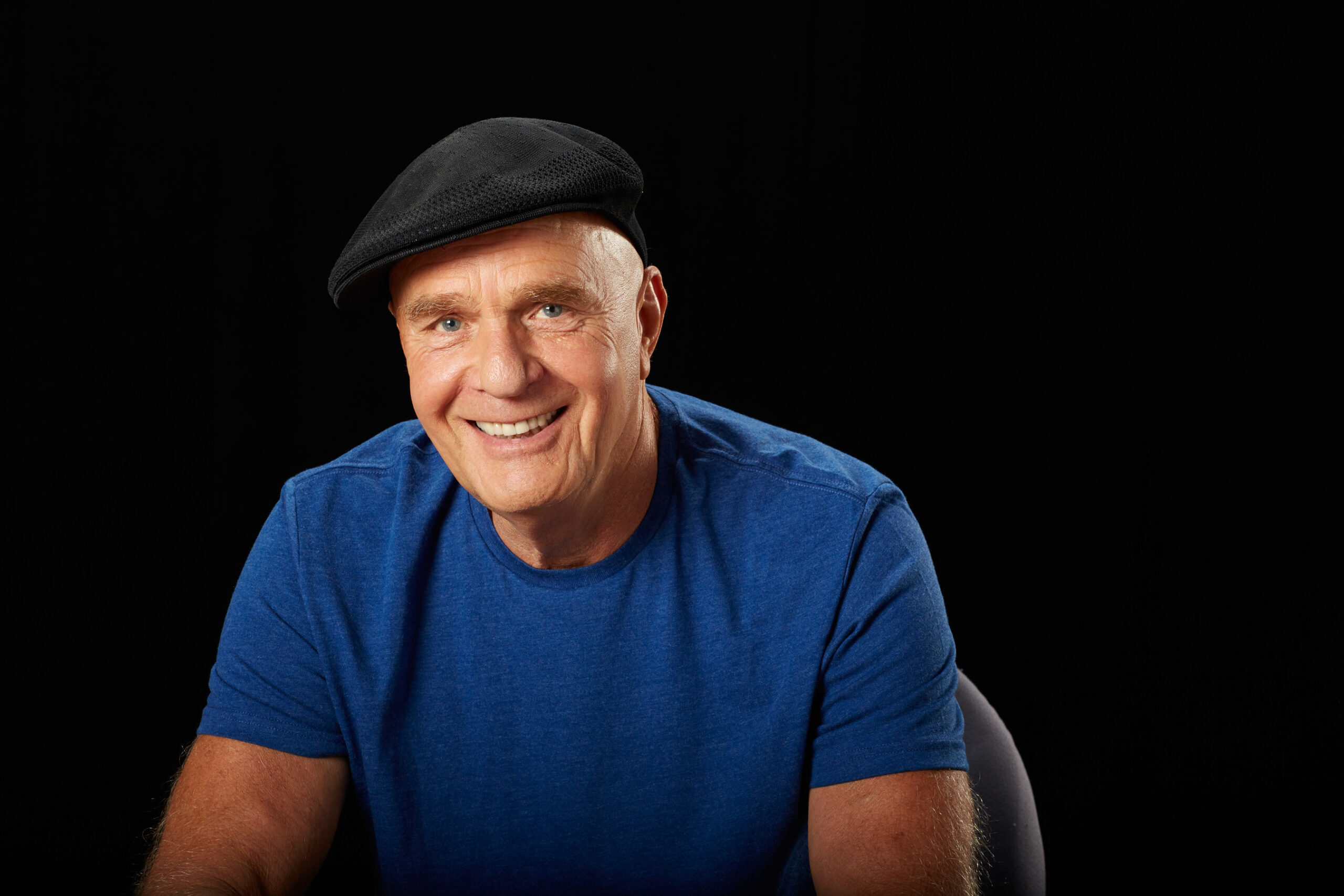

The Freedom Hidden in Your Own Perception: Wayne Dyer on Shifting How You See
There is a particular kind of suffering that has nothing to do with what is actually happening and everything to do with the story being told about it. Two people can walk through the same experience — a job loss, the end of a relationship, an illness, a disappointment — and emerge from it in completely different psychological states. One carries it as a wound for years. The other finds, somewhere inside it, the seed of something useful. The circumstances were identical. What differed was the lens.
This observation sits at the very heart of one of Wayne Dyer’s most repeated and most misunderstood teachings.
The Mantra That Sounds Simple Until It Isn’t
“If you change the way you look at things, the things you look at change.” Wayne Dyer repeated this line so often across his career that it became almost synonymous with his name. And because it is compact and quotable, it is also easy to receive too quickly — to nod at it, file it away as a pleasant thought, and continue seeing the world in exactly the same way as before. That would be a significant mistake, because what Dyer was pointing at is neither a piece of motivational decoration nor a call to naive optimism. It is a precise description of how human consciousness actually works.
The mind does not passively receive reality like a camera recording what is in front of it. It actively constructs what it sees, selecting certain details, ignoring others, running every perception through a dense filter of past experience, belief, expectation, and habit. What you are convinced is an objective view of a situation is, in every case, a deeply subjective interpretation. Dyer’s invitation was not to replace one interpretation with a rosier one, but to become aware that interpretation is happening at all — and that you have far more agency over it than you have been led to believe.
Perception as a Learned Habit
The psychologist Albert Ellis, whose Rational Emotive Behavior Therapy Dyer engaged with early in his career, argued decades ago that it is not events themselves but our beliefs about events that generate emotional distress. Dyer absorbed that insight fully and then took it somewhere Ellis never quite went — into the territory of spiritual transformation, where the shift in perception is not merely a therapeutic technique but a doorway to an entirely different relationship with existence itself.
The key word Dyer returned to repeatedly was choose. He was uncompromising on this point in a way that initially strikes many people as either liberating or infuriating, depending on where they are in their own journey. He insisted that suffering, in the vast majority of cases, is not inflicted upon you from outside. It is chosen — not consciously, not maliciously, but habitually. You have been practicing certain ways of interpreting events for so long that they feel automatic, fixed, and true. But practice, by definition, can be changed.
This is not a claim that painful things don’t happen. Loss is real. Injustice is real. Grief is real. Dyer never pretended otherwise, and his own life — with its childhood abandonment, its broken marriages, its diagnosis of leukemia — gave him no room for the kind of spiritual bypassing that dismisses pain with a wave of the hand. What he was pointing at is the layer of additional suffering that accumulates on top of genuine pain through resistance, rumination, and the compulsive need to control what cannot be controlled.
The Trap of Needing Things to Be Different
One of the most concrete expressions of this teaching concerns what Wayne Dyer called the need to control outcomes. The ego, he observed, is perpetually at war with reality. It has a fixed idea of how things should be — how people should behave, how situations should unfold, how life should reward effort — and it spends enormous energy reacting with frustration, resentment, or despair every time reality fails to cooperate. This orientation, which most people simply call caring about your life, is actually one of the primary engines of human unhappiness.
The Stoic philosophical tradition, which maps remarkably well onto what Dyer was teaching, draws a sharp distinction between what lies within our control and what does not. Dyer arrived at the same distinction from a more Eastern direction, shaped by his study of the Tao, of Buddhism, and of Vedanta. All of these traditions agree on a single uncomfortable truth: the external world will never arrange itself permanently to your satisfaction. The variable that can change is the perceiver, not the perceived.
When you release — genuinely release, not just intellectually accept — the demand that circumstances be other than they are, something unexpected happens. The mind, which had been contracting around the problem, begins to open. And in that opening, options become visible that were previously invisible. This is not magical thinking. It is closer to something quite practical: a mind gripped by resistance and judgment is a mind whose attention is almost entirely consumed by what it doesn’t want. The moment the grip loosens, attention becomes available for something else.
Seeing With New Eyes
Dyer loved Marcel Proust’s line that the real voyage of discovery consists not in seeking new landscapes but in having new eyes. It captured precisely what the shift in perception is actually about. You do not need to wait for your circumstances to change before you begin experiencing something different. The transformation available to you is interior, and it is available right now, not after the situation resolves or the person changes or the world cooperates.
A practice Dyer recommended was simply to catch yourself in the act of labeling an experience as bad, wrong, or threatening — and to pause long enough to ask: is this interpretation serving me? Is there another way to see this that is equally or more true? Not forcing false positivity, but genuinely opening the question. Often, what presents itself initially as an obstacle contains within it something that a more rigid perception simply cannot see.
“When you squeeze an orange,” Dyer would say, “orange juice comes out, because that’s what’s inside. When you are squeezed — when life puts pressure on you — what comes out is what’s inside you.” The aim of working with perception is not to eliminate the pressure. It is to change what’s inside, so that what emerges when pressure comes is something closer to clarity, compassion, and equanimity than to fear, blame, and contraction.
The Practice of Allowing
The culmination of this teaching is what Wayne Dyer simply called allowing — the willingness to meet what is without immediately requiring it to be something else. This is far more radical than it sounds. It does not mean passivity or resignation. It means approaching each moment with enough inner spaciousness that your response to it can come from something wiser than habit and fear. It means trusting, as Dyer did, that a universe intelligent enough to produce consciousness is also intelligent enough to be worked with rather than constantly fought.
The shift in perception he described is less like changing your mind and more like relaxing the fist of the mind — discovering that what you were gripping so tightly was never actually necessary to hold.