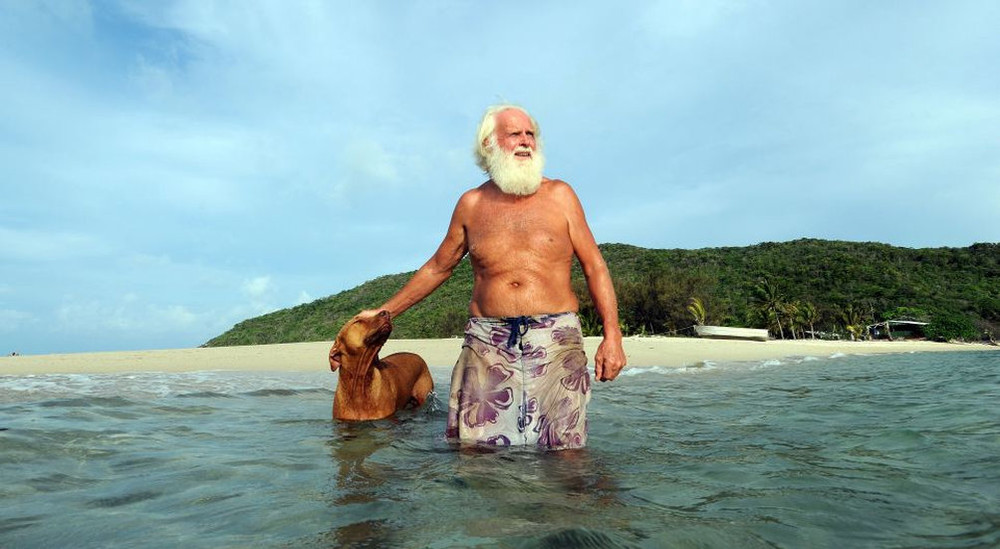

What Brendon Grimshaw Can Teach You About Living on Purpose
A Stranger, an Island, and a Question That Changed Everything
In 1962, a 37-year-old British journalist named Brendon Grimshaw found himself at a crossroads. He had built a respectable career working as a newspaper editor across East Africa — first in Kenya, then in Tanzania. But the world around him was shifting. African nations were claiming their independence, and jobs like his were passing to local hands. He was not being pushed out in any dramatic way. He was simply standing at the edge of one chapter, wondering what the next one would look like.
He went on holiday to the Seychelles. Not with a plan. Not with a vision board. Not with a five-year strategy. He just went. And on the second-to-last day of that holiday, a local man approached him and asked if he’d be interested in buying an island.
The island was called Moyenne. It was 9.9 hectares of overgrown scrub, abandoned since 1915, so choked by weeds that — as one observer later put it — falling coconuts never even hit the ground. There were no birds. Rats ruled the place. It was, by every conventional measure, a ruin.
Brendon Grimshaw stepped onto its shore, and something inside him shifted. He recalled it years later: “It was a special feeling. That this is the place I’ve been looking for.”
He bought the island for £8,000. And then he got to work.
Your Purpose Doesn’t Wait for You on the Couch
Here is the first thing worth sitting with: Brendon Grimshaw did not discover his life’s calling through meditation, journaling, or a weekend retreat. He found it by moving — by actually going somewhere, putting his feet on the ground, and being present enough to recognize a moment when it appeared.
This is a truth that most of us would rather not hear, because it demands something of us. The modern tendency is to wait for clarity before acting. To seek the vision before taking the step. To want the destination perfectly mapped before daring to leave the house. But life rarely works that way. Purpose tends to reveal itself through action, not through anticipation.
Grimshaw was not the kind of man who had always dreamed of owning a tropical island and restoring an ecosystem. He was a journalist. That was his craft, his identity, his profession. And then one day — through a combination of curiosity, openness, and the willingness to simply show up — he walked into a story far greater than any he’d ever written.
The island didn’t come to him. He had to move toward an undefined horizon before the invitation appeared. And when it did, he had to have the courage to say yes to something that made no logical sense whatsoever.
You might be waiting for your own version of that moment. And it may well be waiting for you — just slightly beyond where you’re currently standing.
The Peculiar Path That Others Won’t Understand
Let’s be honest about what Brendon Grimshaw’s life looked like from the outside. A professional man in his prime, with skills and experience, choosing to leave civilization and go live alone on a neglected island in the Indian Ocean with a young Seychellois man named René Lafortune as his only companion. No running water at first. No electricity. Hands blistered from planting trees in the tropical heat. Rowing to the main island to collect barrels of fresh water by hand.
This is not what a sensible person does. This is not the kind of lifestyle choice that gets enthusiastic approval at dinner parties. This is the kind of choice that prompts people to quietly wonder if you’ve had some sort of breakdown.
And yet.
There is a category of human being who simply cannot live someone else’s version of a good life. Who feels the pull of something that doesn’t fit neatly into the approved narrative of success and respectability. Who, when they are honest with themselves, knows that the conventional path — however comfortable, however socially validated — is not their path.
If you have ever felt that pull and suppressed it because it seemed impractical, because people wouldn’t understand, because you couldn’t explain it in rational terms — then Grimshaw’s story is speaking directly to you.
The question is never whether others will understand your path. They often won’t, and that’s not the point. The question is whether you are willing to walk it anyway. Grimshaw walked his path for fifty years, and the world eventually built a national park around his conviction.
Alone, But Never Lonely
By the time René Lafortune passed away in 2007, Brendon Grimshaw was 81 years old, living alone on a 9.9-hectare island surrounded by the Indian Ocean. No partner. No children. No neighbors. Just tortoises, birds, fruit bats, and the slow, green company of 16,000 trees he had planted with his own hands.
And yet he was explicit about this: he never felt lonely.
This is worth pausing on, because loneliness has become one of the defining anxieties of our time. We accumulate relationships, notifications, social engagements — partly out of genuine connection, and partly out of a deep fear of being left alone with ourselves. We fill silence. We reach for the phone. We mistake the absence of noise for the presence of emptiness.
But Grimshaw knew something that takes most people a lifetime to understand, if they learn it at all: that solitude and loneliness are not the same thing. Loneliness is the feeling of being disconnected from meaning. Solitude, at its deepest, is the experience of being entirely at home within it.
When your days are woven into something that matters to you — when every morning brings the same quiet purpose, when the trees you planted years ago are now taller than you can reach, when the birds that return each season are returning partly because of choices you made — you are never truly alone. You are in conversation with life itself.
Grimshaw was not disconnected from the world. He had a mobile phone. His sister and brother-in-law lived on the main island. Day-trippers came regularly to walk his forest paths and meet his tortoises. But his fundamental nourishment came not from constant human contact, but from something older and quieter — from being genuinely embedded in a place, from having given himself fully to something that gave back in ways that money cannot purchase.
The $50 Million No
This may be the most instructive moment in the entire story.
As Moyenne Island became more beautiful, as its ecosystem flourished and its reputation spread, developers began to circle. The Seychelles were becoming a destination for luxury tourism, and a private island of that calibre — pristine, ecologically rich, with its own restored forest and exotic wildlife — was an extraordinary prize. Offers came in almost daily through the 1980s. Eventually, one came from a Saudi prince: $50 million for the island.
Brendon Grimshaw said no.
To every potential buyer, his first questions were always the same: What will happen to the tortoises? Where will the birds nest? What about the fauna? Not: what’s your offer? Not: can we negotiate? Not: let me think about it. He simply needed to know whether the buyer understood what the island actually was — and no buyer ever did, because no buyer was willing to see it as anything other than real estate.
There is a profound teaching embedded in this refusal, and it has nothing to do with romanticizing poverty or dismissing the value of financial security. Grimshaw was not making a sacrifice. He was simply operating from a completely different definition of wealth than the one being offered to him.
Wealth, in the truest sense, is abundance of what actually matters to you. And what mattered to Grimshaw was the island — its health, its future, its creatures, its trees. He had already arrived. There was nothing the $50 million could give him that he didn’t already have, and a great deal it would take away.
Most of us will never face an offer of $50 million. But all of us face, in smaller and more frequent ways, the choice between what the world values and what we actually value. The question Grimshaw’s life poses is a simple one: do you know the difference?
The Theology of Small Acts
In fifty years on Moyenne Island, Brendon Grimshaw and René Lafortune planted 16,000 trees. They built 4.8 kilometers of forest paths. They introduced tortoises and coaxed birds back to an island that had fallen silent. They brought in ten birds from a neighboring island — and the birds flew away. So they tried again. A few returned. They fed those few. More came. Eventually, over 2,000 birds made the island their home.
None of this was dramatic. None of it happened in a transformative weekend. There was no single moment of breakthrough, no sudden revelation that changed everything overnight. There was just the daily act of showing up, picking up a tool, planting something, caring for something, and doing it again tomorrow.
This is the aspect of Grimshaw’s story that the world most easily overlooks, because we are in love with transformation and suspicious of repetition. We want the before and after. We want the story of the man who bought an island and then it became a paradise. We skip the middle, because the middle is just years and years of quiet, unglamorous, blistered work.
But the middle is the whole story. The middle is where every great thing actually happens.
The tree you plant today will not shade you tomorrow. The practice you begin this week will not make you wise by next month. The relationship you tend carefully for years will not feel profoundly different after any single conversation. But look up a decade from now, and the landscape will be unrecognizable — not because of any single heroic act, but because of the accumulated weight of a thousand small ones.
Grimshaw did not build a national park. He planted trees. Thousands of times. And the national park emerged from that.
What He Left Behind
Brendon Grimshaw died on July 3, 2012, at the age of 86. He was buried on Moyenne Island, next to his father. The island he had purchased as a tangle of weeds and silence was by then a thriving national park — the smallest in the world — legally protected, ecologically irreplaceable, and tended by the Seychellois government in accordance with the trust he had established before his death.
He left no children. He left no corporate legacy. He left no financial empire. He left a forest.
And a forest is, in many ways, the most honest monument a human being can leave. It grows after you. It shelters things you’ll never see. It produces oxygen for lungs not yet born. It is generosity that extends beyond the reach of your own life.
Most of what we build collapses when we stop holding it up. What Grimshaw built kept growing after he let go.
The Island That Was Always Closer Than You Think
You may not have £8,000 and a neglected island waiting for you in the Indian Ocean. But you almost certainly have some version of what Grimshaw found: a calling that doesn’t fit the expected mold, a form of work that matters more to you than its material rewards, a way of living that would confuse the people around you but align you completely with yourself.
The invitation this story extends is not to abandon civilization and go plant trees on a remote island — though if that’s your thing, go ahead. The invitation is simpler and more demanding than that. It is to ask yourself, with real honesty: what would I do if I stopped measuring my life by what others consider valuable? What would I build if I weren’t afraid of being misunderstood? What would I tend to, daily and quietly, if I trusted that the forest would eventually appear?
Brendon Grimshaw found his answer on the second-to-last day of a holiday, on a forgotten island in the Indian Ocean. He spent the next fifty years proving that the answer was right.
The trees don’t lie.