
What Is God According to Baruch Spinoza? (And Why Einstein Agreed)
When Albert Einstein was asked about his religious views, his answer stunned many. He famously declared his belief in “Spinoza’s God,” a concept with no personal deity who judges humanity or answers prayers.
This idea originated with the 17th-century philosopher Baruch Spinoza, who offered a vision of God perfectly aligned with a scientific worldview. For Spinoza, God is the elegant, unchangeable laws of the universe—everything that was, is, and will be.
What Is Spinoza’s God? The Universe, Not Its Creator
Unlike a creator separate from creation, like an artist painting a landscape, Spinoza argued that God is the entire landscape itself. God didn’t create the universe; God is the universe, along with the unbreakable laws of physics and chemistry that govern it.
A God that is the laws of nature—like gravity or cause and effect—cannot have personal feelings, plans, or a will. It isn’t a “who” that listens to prayers or passes judgment. It is the single, underlying substance of all existence unfolding with perfect, logical order—an impersonal principle, not a divine person.
Spinoza gave this concept a Latin name: Deus sive Natura, or “God, or Nature.” This view, known as Pantheism, identifies divinity with the cosmos itself, presenting a universe governed not by miracles but by magnificent and eternal rules.

Why This ‘God of Order’ Fascinated a Scientist Like Einstein
This vision of God naturally resonated with a mind like Einstein’s. A universe governed by consistent, unbreakable laws can be explored and understood through science. Instead of a God who performs unpredictable miracles, Spinoza offers a divinity found in the elegant mathematics of a planet’s orbit and the predictable logic of cause and effect. For a physicist dedicated to uncovering the fundamental rules of reality, this “God of order” wasn’t a matter of faith but of rational admiration.
This belief in absolute order, however, leads to a challenging conclusion. If everything unfolds according to fixed natural laws—like an infinite chain of falling dominoes—then every event is predetermined. Spinoza argued this includes our own actions. The feeling of “free will,” he claimed, is an illusion born from our ignorance of the complex causes behind our decisions. Everything that happens must happen exactly as it does.
Einstein confirmed this view, perfectly capturing why Spinoza’s philosophy appealed to him:
I believe in Spinoza’s God, who reveals himself in the lawful harmony of all that exists, not in a God who concerns himself with the fates and actions of human beings.
What Spinoza’s God Means for Us Today
Spinoza’s philosophy offers a way to bridge the perceived gap between science and spirituality. By defining God as the universe, the impersonal laws of nature and a sense of spiritual awe become two sides of the same divine reality.
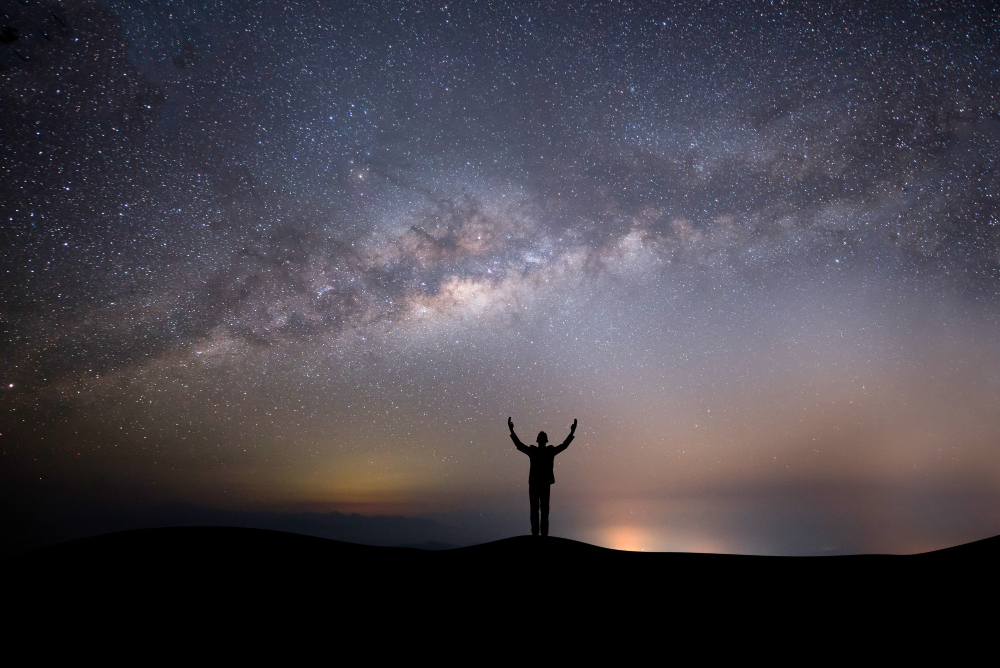
When you feel a sense of awe looking at a star-filled sky, you aren’t just observing nature. You are witnessing the very structure and substance of existence—an experience Spinoza would simply call understanding God.