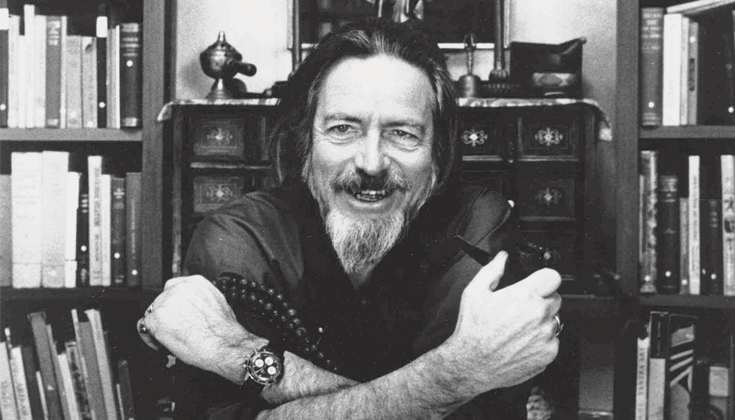

Who Is Alan Watts? A Brief History of the Philosopher and Speaker
The most viral philosopher on social media wasn’t a guru or a saint. He was a British entertainer who loved a good joke, enjoyed a drink, and believed the secret to life was to stop taking it so seriously. His name was Alan Watts, and long before his voice became a soundtrack for online videos, he took on the ambitious task of bridging two vastly different worlds: the ancient wisdom of the East and the hurried mind of the West.
Watts saw his role not as an inventor of ideas, but as a translator. Think of him less as a religious leader and more like a brilliant nature commentator. Just as David Attenborough doesn’t invent the animal kingdom but helps us fall in love with it, Watts didn’t invent Zen Buddhism—he helped the West appreciate its wisdom. After learning from renowned scholars like D.T. Suzuki, he reframed profound concepts into something anyone could grasp.
His goal, in the end, wasn’t to convert you, but simply to make you curious. The lectures were invitations to play with ideas, not commands to believe a new doctrine. This approach—presenting Alan Watts’s philosophy as a way of seeing rather than a set of rules—offered a powerful sense of relief from the pressures of modern life. It’s a key reason why, decades later, so many people are still pressing play.
The Backwards Law: Why Trying Harder Can Make Things Worse
Have you ever found yourself in a loop of overthinking, where the more you struggle against anxiety, the stronger it seems to get? This frustrating experience was at the heart of one of Alan Watts’s most famous concepts, often called the “backwards law” or the law of reversed effort.
At its core, the idea is simple: for certain things in life, the more you consciously try to achieve them, the further away they get. Watts compared it to trying to hold water in your hands. If you squeeze your fist tightly, the water escapes; but if you relax and gently cup your hands, you can hold it. The effort to grab it is precisely what makes it impossible to keep.
This principle shows up everywhere. You can’t force yourself to fall asleep; sleep only comes when you let go of the effort. You can’t make yourself be spontaneously happy; happiness often arrives as a byproduct of engaging in an activity, not by chasing the feeling itself. Forcing a creative idea almost never works, but it often pops into your head while you’re in the shower or on a walk.
For Watts, this wasn’t an argument for laziness, but for a smarter, more graceful way of living. It was an invitation to see that in a world obsessed with control, sometimes the most effective action is to relax your grip. This core idea of letting go didn’t just shape his philosophy; it was woven into the surprising twists and turns of his own life story.
From Priest to Counter-Culture Icon: A Surprising Life Story
Given his Zen-like wisdom, you might picture Alan Watts spending his entire life meditating on a mountaintop. The reality was far more dynamic. Born in England in 1915, he was fascinated by East Asian art and philosophy from a young age. This passion eventually led him to move to the United States in the late 1930s, where his journey took an unexpected turn that deepens the meaning of his work.
Perhaps the most surprising chapter of his life: Alan Watts became an ordained Episcopal priest. For five years, he led a congregation, deeply immersing himself in the Christian tradition he was born into. This wasn’t a brief phase; it was a genuine attempt to find answers within the framework of Western religion. His eventual departure from the church wasn’t a rejection of spirituality, but a realization that his path lay outside of traditional religious institutions.
Leaving the priesthood behind, Watts moved to California in the 1950s and found his true calling. He began teaching at the American Academy of Asian Studies in San Francisco, placing him at the epicenter of the Beat Generation and the budding 1960s counter-culture. His public lectures and radio talks became legendary, offering an intoxicating blend of ancient wisdom, sharp wit, and a playful disregard for stuffy authority.
This unique journey—from the formal church to the free-spirited West Coast—is what made his perspective so powerful. He wasn’t just an academic studying Eastern thought from afar; he had wrestled with the biggest spiritual questions from both sides. This personal exploration shaped his most profound ideas, especially his view on the nature of reality and our place within it.
Are You a Wave or the Ocean? What Watts Believed About God
This journey from priest to philosopher naturally leads to a big question: what did Alan Watts believe about God? He offered an answer that was radically different from the one he once preached from the pulpit, shifting away from a divine ruler and toward something much closer to home.
Instead of seeing God as a separate creator in the heavens, Watts presented an idea central to philosophies like Taoism: that the universe itself is the ultimate reality. He suggested we aren’t just in the universe; we are the universe. To make this mind-bending concept feel intuitive, he often turned to a beautiful and simple analogy that remains one of the key concepts in his teachings.
Imagine a single wave in the ocean. The wave has a temporary identity—it rises, crests, and disappears. But is it ever truly separate from the ocean? Of course not. It’s simply what the entire ocean is doing in that particular place at that particular time. For Watts, each one of us is like that wave. We aren’t isolated egos dropped into the world; we are a temporary form that the whole universe is taking.
This perspective completely reframes our place in everything. It challenges the familiar idea of a God who is separate from creation, like a potter is from a pot. For Watts, the universe wasn’t a thing God made; it was what God is. In his view, you aren’t just a visitor on Earth; you are a way the entire cosmos is experiencing itself, right here and now.
How Did Alan Watts Die? The Man and His Legacy
After a lifetime spent exploring consciousness, the question of how Alan Watts died often arises. He passed away peacefully in his sleep on November 16, 1973, at the age of 58. While he had faced health challenges, his death at his home in California was attributed to heart failure. For a man who taught so eloquently about accepting the natural flow of life, his end was a quiet, undramatic closing to a vibrant and influential story.
However, the story of Alan Watts’s personal life and family reveals a man far more complex than his serene lectures might suggest. He was married three times and struggled with alcoholism, a reality that often surprises those who only know his calm, authoritative voice. This contrast highlights a common tension: the gap between the beautiful ideals a person can articulate and the often messy, imperfect realities of their own human experience.
Watts himself never claimed to be a perfect guru; he preferred the title of “spiritual entertainer.” He saw his role not as a model to be imitated, but as a catalyst for curiosity. His enduring legacy, therefore, isn’t a flawless path to follow. Instead, it’s a collection of powerful ideas that continue to give millions a new lens through which to see themselves and the world.
Where to Start Your Journey: Best Alan Watts Books & Lectures for Beginners
Diving into Watts’s vast collection of work can feel overwhelming, but a few entry points stand out for new listeners and readers. The best place to start depends on how you prefer to learn: his books offer focused, structured arguments, while his recorded lectures capture the spontaneous wit and conversational charm that made him famous.
For those looking for the best Alan Watts books for beginners, these two are consistently recommended. Their clear and direct style makes his biggest ideas immediately accessible.
- The Wisdom of Insecurity: His most popular work, this book is a powerful antidote to modern anxiety, arguing that true security is found by embracing uncertainty and living fully in the present.
- The Way of Zen: If you want to understand his influences, start here. This is a famously clear guide that breaks down Zen’s core ideas, offering a summary and its themes without confusing jargon.
To hear the man in his element, seek out his lectures online. The “Out of Your Mind” collection, widely available on platforms like YouTube and Spotify, is the perfect way to experience his captivating speaking style. Each of these works, in its own way, guides you toward the same liberating idea: the freedom that comes from accepting you don’t need to have all the answers.
The Freedom of Not Knowing: Why Alan Watts Is More Relevant Than Ever
The next time you hear that calm, British voice drifting through a social media feed, it will no longer be a mystery. You’ll recognize the philosopher behind the audio clip—the thinker who acted as a bridge, translating complex ideas into a simple, powerful reminder that you are not a visitor in the world, but a feature of it.
Applying Watts’s philosophy can be a practical first step. Start by simply noticing moments where you’re trying too hard or forcing an outcome. You don’t have to fix anything, just observe the feeling. Once that becomes familiar, try listening to one of his full lectures and let the ideas wash over you without pressure.
His work isn’t about providing a map, but about encouraging you to trust your own journey. Perhaps the freedom he spoke of wasn’t about finding all the answers, but about becoming comfortable with the questions. What if the goal was never to solve the great mystery of your life, but simply to enjoy living within it?