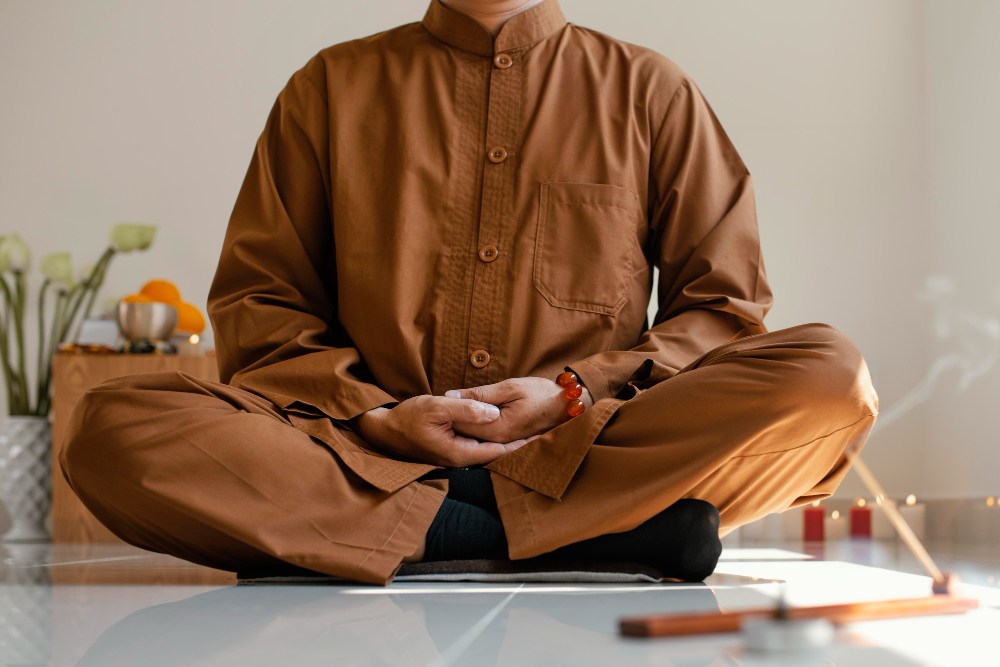

Why is meditation so important in Hinduism?
When you begin to explore Hinduism, you will quickly notice that meditation is not just a relaxation technique, but a central pillar of spirituality. It is more than just closing your eyes and trying to calm your thoughts – it is a path to the deepest knowledge of yourself and transcending the world of appearances. In Hinduism, meditation (dhyāna) is a practice through which you can discover your true nature and experience unity with the absolute. So why is it so important?
Meditation as a path to liberation
Your ultimate goal, if you follow the path of Hinduism, is mokṣa – liberation from the endless cycle of birth and death, called saṃsāra. Ordinary life, full of attachments, desires, and fears, binds you to this wheel of rebirth.
Meditation gives you the opportunity to gradually calm your senses and quiet your mind. As your thoughts subside, you begin to realize that you are neither your body, nor your emotions, nor even your mind. You discover something deeper within yourself – ātman, the eternal “I” that is identical with brahman, or the absolute. This discovery is not a theory, but a direct experience that leads to freedom from suffering and complete peace.
The philosophical basis of meditation
According to Hinduism, your mind functions like a restless lake on a daily basis – it reflects images of the world, but does not give you clarity in itself. Illusion (māyā) causes you to identify with what is changeable and impermanent: your body, thoughts, and social roles. Meditation is a way to clear the surface of this lake and look deeper. Instead of looking at changing reflections, you can experience the depth itself – the pure consciousness that has always been within you. Patañjali’s Yoga Sutras are clear: yoga is “the cessation of the movements of the mind.” Thanks to this, you stop identifying with the chaotic waves of thoughts and begin to experience yourself as a witness to everything that is happening.
The spiritual meaning of meditation
Meditation in Hinduism is not just a practice on a cushion – it is a way to transform your entire life. When you learn to observe your thoughts instead of succumbing to them, you gradually begin to free yourself from the power of the ego and attachments.
As a result, your daily experiences take on new meaning: You begin to see unity where you previously saw division.
Instead of chasing desires, you feel peace and fulfillment.
You open yourself to the experience of divinity not as something distant, but as something that has always been present within you. In this way, meditation becomes not so much a practice as a path back to oneself. It is meditation that makes Hinduism not just a belief system, but a living spiritual experience that you can discover at any moment.
Meditation as a path to connection with God/the Creator
Hinduism does not provide a single, rigid image of God – sometimes it speaks of Brahman, an infinite, formless reality, other times of Īśvara, a personal God whom you can worship in the form of Vishnu, Shiva, or Krishna. However, regardless of how you understand divinity, the goal of meditation is to experience unity with it. If you follow the path of knowledge, meditation leads you to the realization that your “self” and the absolute/Creator are one. If you follow the path of devotion, your practices will focus on contemplating the divine form and repeating its names until your heart is completely united with God. In classical yoga, many years of meditation practice lead to samādhi, a state of complete dissolution of the ego and immersion in the divine whole.
This is why meditation is so important in Hinduism – it is not about momentary calm, but about a fundamental transformation of your view of yourself, the world, and the Creator. It is a path that leads you from illusion to truth, from chaos to calm, from a sense of separation to an experience of unity.