
What Yin and Yang Can Teach Us About Harmony and Avoiding Extremes
We’re often told to “find balance,” but that goal can feel impossible. What if the answer isn’t about standing perfectly still, but learning to flow with life’s natural rhythms?
A surprisingly practical guide lies within an ancient symbol: the familiar yin-yang circle is more than a cool design; it’s a map for finding harmony. It reveals how opposing forces like intense work and deep rest are not enemies to be conquered, but partners in a dance. This framework shows us that the key to inner balance isn’t a rigid 50/50 split, but a dynamic, flowing exchange. By understanding yin and yang, we can move from constant struggle to sustainable energy and calm.

What Are Yin and Yang? Beyond Black and White
At the heart of the famous symbol are two fundamental energies: yin and yang. It’s tempting to see them as opposites in a battle, but it’s more accurate to view them as a team, like an inhale and an exhale. You can’t have one without the other; together, they create the rhythm of life.
Yang represents the energy of action, brightness, and outward expression. It’s the sun on a summer afternoon, the buzz of a productive morning, or the drive to achieve a goal. When you’re talking, moving, or creating, you are in a state of yang. It’s the “doing” part of your day.
Yin, in contrast, is the energy of rest, quiet, and inward reflection. It’s the stillness of the night, the coolness of shade, or the peace from simply being present. When you’re listening, resting, or sleeping, you are nurturing your yin side. It is the essential “being” that recharges your ability to do.
Neither force is better or more important – a healthy life requires both in a constant, flowing exchange. True harmony isn’t found by picking a side, but by appreciating the natural rhythm that flows between them.
Why “Perfect Balance” Is a Myth: Embracing the Flow
Many of us chase a “perfectly balanced” life, imagining a scale that never tips. This pressure to maintain a static 50/50 split is exhausting. The principle of yin and yang isn’t about achieving a fixed state; it’s about embracing a constant, graceful flow. The goal isn’t balance, but the continuous act of balancing.
Think of a tightrope walker. Their skill isn’t in standing perfectly still – that would make them fall. Instead, they make thousands of tiny, constant adjustments, shifting their weight to stay upright. This dynamic dance is a much more realistic model for our own lives. Some weeks demand more yang energy for a big project, while the following days call for deep yin rest. Seeing this ebb and flow not as a failure but as the definition of health frees us from pursuing an impossible ideal.
The Secret in the Dots: Why Extremes Always Backfire
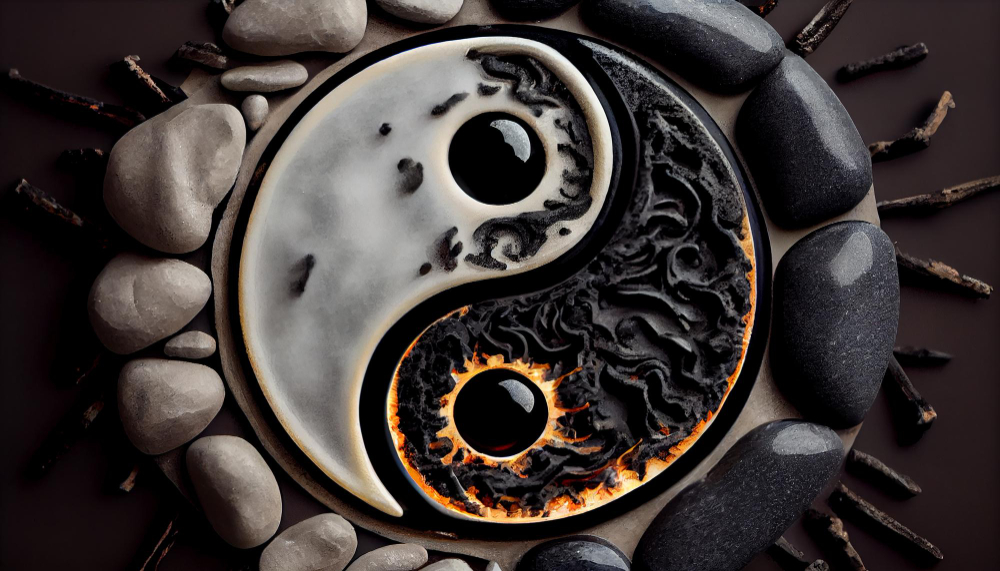
Look closely at the yin-yang symbol, and you’ll notice a small dot of the opposite color in each half. This represents the “seed of the opposite,” teaching a profound truth: nothing is ever 100% yin or 100% yang. Within every state lies the beginning of its counterpart.
This principle plays out everywhere. At the hottest part of a summer day (peak yang), you begin to crave cool shade (the seed of yin). Likewise, in the deepest moment of rest, ideas for your next project begin to stir. Pushed to its extreme, any state will naturally transform into its opposite.
This serves as a powerful warning against burnout. When we push relentlessly into pure yang – all work, all hustle – we ignore the seed of yin calling for rest. By trying to eliminate one side, we guarantee it will come roaring back as exhaustion or a creative crash. The secret is to honor the small seed of the opposite before it becomes an emergency.
How to Apply Yin and Yang to Your Work-Life Rhythm
Our professional lives are a clear example of this dynamic. A day packed with meetings and deadlines is a state of powerful yang. While necessary, staying in that mode without a counterbalance is a direct path to burnout. Your mind and body are signaling that the seed of yin is ready to sprout.
The goal isn’t to eliminate the hustle, but to intentionally weave in its opposite. Adding yin to your workday doesn’t require a dramatic change; it’s about making small, conscious choices to offset the constant output. It might mean closing your email for an hour to focus on a single task (yin) instead of multitasking (yang). It could be taking a lunch break away from your desk, without screens, to simply decompress.
Here’s a simple way to start: after a demanding meeting, don’t jump into the next task. Instead, take five minutes to stand up, stretch, or look out a window in silence. By honoring that small need for yin, you restore your rhythm and approach the rest of your day with calm instead of frazzle.
Finding Your Wellness Balance: More Than Just Diet and Exercise
This same principle of harmonizing energies applies to our physical health. A wellness world that glorifies high-intensity workouts is promoting a purely yang pursuit: running faster, lifting heavier, constantly doing. While vital for strength, focusing only on this outward expression is like trying to breathe in without ever breathing out.
To complete the cycle, we need the yin side of wellness: gentle stretching, a quiet walk, meditation, or a full night of sleep. These aren’t moments of laziness; they are active recovery where your body repairs tissue and builds resilience. The intense yang of exercise creates the need for the deep yin of restoration. A truly healthy lifestyle creates a rhythm between them, a graceful dance between effort and ease.
The Art of Conversation: Balancing When You Talk and When You Listen
In any dialogue, expressing your thoughts is a form of yang – active and outward. True connection also requires yin: the quiet, receptive energy of listening. We’ve all felt the exhaustion of a conversation that is all yang, where everyone is talking but no one is heard. It feels more like a competition than a connection.
A meaningful discussion flows between sharing and receiving. When one person speaks (yang), it creates a natural opening for the other to absorb and reflect (yin), gathering energy for their own response. The next time you’re speaking with someone, try consciously creating more yin. Ask a question and truly absorb the answer without planning what you’ll say next. This small shift from asserting to receiving is a powerful, real-world exercise in finding balance.
Your Guide to “The Middle Way”: Living in Harmony
The phrase “The Middle Way” can be misleading, suggesting a life of bland compromise. Instead, think of it as skillful navigation. A surfer doesn’t avoid the wave; they find balance by expertly riding its powerful curve. This is the essence of the Middle Way: flowing with the full spectrum of energy without getting swept away by either extreme.
When you stop fighting these natural currents, your efforts feel aligned, not draining. This is “effortless action.” It isn’t laziness; it’s the difference between pushing a “pull” door versus simply pulling it. By honoring the need for both work (yang) and rest (yin), you learn to act with the right energy at the right time, achieving more with less struggle. This approach replaces the feeling of being overworked with a sense of centered, sustainable energy.
How to Start Finding Your Balance Today
The search for balance is not another stressful item on your to-do list, but a gentle rhythm to be found. Harmony isn’t about standing still; it’s in the graceful dance between your energy out and your energy in.
To find your rhythm, simply ask yourself: Where in my life do I feel too much ‘yang’ – too much hustle, noise, and activity? Following that, what is one small ‘yin’ moment of rest or quiet I can introduce this week?
This isn’t about getting it right all the time. The goal is to embrace imperfection for mental harmony. Think of this perspective not as a rule, but as a compass – a forgiving tool you can always use to find your way back to center.