
How to Experience Spirituality Instead of Just Reading About It
If your spirituality lives only in your mind, it is not yet spirituality. It is spiritual entertainment. It is the equivalent of reading every book ever written about swimming without once getting into the water. And there is nothing wrong with the books themselves – the problem is mistaking the map for the territory.
True spiritual understanding is not a concept you arrive at. It is something that happens to you. Or more precisely, something you allow to happen. And then, quite suddenly, you don’t need anyone to explain what presence is, or what non-duality means, or why mystics throughout history kept pointing to the same wordless thing. You know it. Not from your head, but from somewhere far more reliable.
The foundation of all genuine spiritual experience is the ongoing practice of presence – what contemplative traditions have called mindfulness, watchfulness, awareness, witnessing. This is the bedrock, the soil in which everything else grows. Without it, even the most powerful spiritual encounter tends to evaporate like a dream by midmorning. But there are also certain things you can do, circumstances you can create, environments you can enter, that dramatically increase the likelihood of a genuine breakthrough. Here are some of the most potent ones.
Solitude and Silence: The Oldest TechniqueThere Is
Every wisdom tradition on earth has placed silence and solitude at the center of its practice. Moses went into the desert. The Buddha sat beneath a tree. Jesus fasted in the wilderness for forty days. This is not a coincidence.
Set aside one full day, preferably in nature, away from your ordinary environment, with no phone, no books, no music, no conversations, no people at all, no tasks to complete. If you can add a light fast or reduce yourself to a single simple meal, do so. What you are doing is removing the noise. And in that silence, which will feel deeply uncomfortable at first, something begins to surface. Not boredom, though that comes first. Beneath the boredom is restlessness. Beneath the restlessness is anxiety. Beneath the anxiety, if you stay long enough, is something else entirely – a stillness that does not belong to you, that was there before you arrived and will remain after you leave.
This is not poetic language. This is what actually happens when you stop feeding the mind its usual diet of stimulation. The inner landscape reveals itself. And once you have felt it, even for a moment, you will understand in your bones why every genuine teacher since the beginning of recorded history has called silence the doorway to the sacred.
Sustained Contemplation
Pick an object. A candle flame is ideal – there is a reason fire has been used in meditation and ritual across virtually every culture in human history. A flowing river works equally well. Sit with it for two hours, without distraction, without agenda. Simply look. What tends to happen around the ninety-minute mark, for many people, is a subtle but unmistakable shift in perception. The flame stops being a thing you are watching and becomes something you are participating in. The boundary between observer and observed softens. For a moment, or perhaps longer, there is no clear line between where you end and the fire begins.
This is not imagination. It is a direct experience of what Hindu philosophy calls Advaita, non-duality, and what modern consciousness researchers increasingly recognize as a fundamental feature of awareness itself. Arthur Zajonc, a physicist and contemplative practitioner, spent decades exploring the intersection of light, consciousness, and perception. His conclusion, which mirrors what meditators have been saying for centuries, is that the observer and the observed are far more entangled than ordinary thinking allows. Sustained contemplation is one of the most accessible ways to feel this for yourself.
Ceremony, Ritual, and the Power of Gathering
There is a particular quality of energy that arises when people come together with genuine intention. Something happens in a room full of people beating drums, or sitting in silence together at a gong concert, around a fire, or drinking ceremonial cacao and setting intentions, that simply does not happen alone. This is not romanticism – it is a recognizable, repeatable, felt phenomenon.
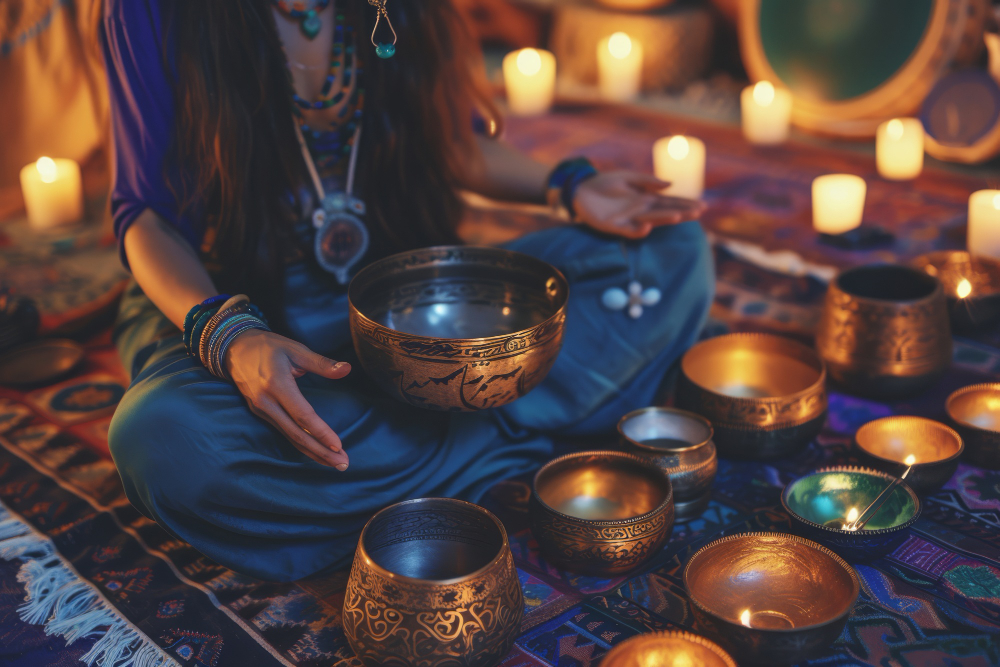
Shamanic fire ceremonies, group meditations, sound healing events with Tibetan singing bowls, breathwork circles – these are all doorways. They work, in part, because ritual creates a container. It signals to the energetic system that something different is happening, that this time and space have a different quality from ordinary life. The body relaxes its defenses. The ego finally shuts down. And in that loosening, things become possible that are otherwise closed off. If you have never attended something like this, go. Find a local cacao ceremony, a gong bath, a breathwork class. Go without expectations. Sit in the room and let the energy flow.
Lucid Dreaming and Out-of-Body Experience
These two practices require patience, sometimes months of consistent effort, but the territory they open up is genuinely extraordinary. A lucid dream is a dream in which you know you are dreaming, and therefore move through it with full waking awareness. An out-of-body experience, or OOBE, is a state in which awareness seems to separate from the physical body entirely, and you find yourself moving through a space that feels more real than ordinary waking life.
What makes these practices spiritually significant is not the exotic experiences themselves, but what they reveal about the nature of consciousness. When you become lucid inside a dream, you realize with startling clarity that the entire reality you were inhabiting – the buildings, the people, the physical sensations – was being generated from within. This has an irreversible effect on how you relate to waking life. The solidity of ordinary reality becomes, if not an illusion exactly, then at least a question worth asking.
If you are drawn to this, begin with a dream journal – record every dream immediately upon waking. Practice reality checks throughout the day. Study the methods developed within the Monroe Institute or the work of Robert Waggoner, whose research on lucid dreaming as a spiritual tool is as rigorous as it is fascinating. The doorway takes time to find. But once you pass through it, the inside of your own consciousness becomes a landscape of genuine exploration.
Hypnosis and Regression
Hypnosis and past-life regression work differently from the practices described above – rather than expanding outward into broader states of consciousness, they move inward and backward, into layers of memory and experience that the analytical mind typically cannot access. Whether you believe in literal past lives or interpret regression experiences as symbolic material generated by the deep psyche, the healing that can occur in these states is real and often profound.
What hypnosis and regression make possible is direct contact with parts of yourself that have been walled off – old wounds, old patterns, old stories that continue to shape your behavior without your conscious knowledge. To enter that material, to see it, to understand its origin, and to offer it something different – that is a transformation that goes far beyond what intellectual self-analysis can achieve. If you have emotional patterns that seem stubbornly immune to ordinary therapy or understanding, this is a territory worth exploring with a qualified and experienced practitioner.
Places of Power
There are places on this earth that do something to people. You can debate the mechanism – ley lines, geomagnetic anomalies, the accumulated energy of thousands of years of prayer and ceremony – but the experience itself is difficult to argue with. Mount Shasta in California, Stonehenge in England, the pyramids at Giza, Mount Kailash in Tibet, the Wawel Castle in Kraków – these are among the most well-known of what many traditions call power places or earth chakras. People travel to them from every corner of the world, drawn by something they often cannot fully articulate.
But the key distinction is this: going to Stonehenge to take a photograph is tourism. Going to Stonehenge to sit in silence for several hours, to meditate, to breathe, to genuinely open yourself to whatever the place carries – that is pilgrimage. These are entirely different activities. And you do not need to travel to the other side of the planet to have this experience. Most regions have their own places – forests, hilltops, ancient sites, springs – that locals have quietly known about for centuries, sometimes dismissing them as haunted or paranormal. Those labels are often just the folk vocabulary for the same phenomenon. Seek these places out. Sit in them. Be still. Listen with your whole body, not just your ears.
A Word on Plant Medicines
There are substances, like ayahuasca or psilocybin mushrooms, that have been used for thousands of years by indigenous traditions precisely because of their capacity to dissolve the ordinary boundaries of consciousness and deliver experiences that are, by any reasonable description, spiritual. The research emerging from institutions like Johns Hopkins and Imperial College London suggests that these experiences can be genuinely transformative, particularly for people dealing with grief, addiction, depression, or existential crisis.
This path is not for everyone, and it is not without risk – physical, psychological, and legal, depending on where you live. It requires careful preparation, a responsible and experienced guide, the right set and setting, and genuine respect for what you are entering. If you feel drawn to this direction, do not rush. Educate yourself thoroughly. The plant medicines themselves, according to every tradition that has worked with them, are not to be approached casually. Treat this path with the seriousness it deserves, and it may offer you something that changes the trajectory of your life. Treat it carelessly, and it will show you that, too.
The Invitation
None of what is described above is a shortcut. Even the most dramatic single experience – the most vivid lucid dream, the most electric ceremony, the most profound moment of silence on a mountaintop – means nothing if it does not begin to change how you live, how you treat others, how awake you are in the unremarkable moments of an ordinary day. The experiences are not the destination. They are evidence that what you have been reading about is real. They are the first breath of a language you will spend a lifetime learning to speak.
Start somewhere. Start with one day of silence. Start with a candle and two hours and no agenda. Start by finding out if there is a sound healing event or a breathwork class somewhere near you this month. The invisible world does not ask you to be ready. It only asks you to be willing.